Our Debt Free Family

Commit. Plan. Take action.

  • BUDGETING
  • Debt Reduction
  • INVESTING
  • LIFESTYLE
  • TOOLS
  • ABOUT
  • Privacy Policy
  • CONTACT

3 Free Printable Debt Free Charts and Trackers to Help You Reach Financial Freedom

March 21, 2024 | Leave a Comment

<p>We are looking forward to establishing some awesome New Year’s resolutions for our finances at the end of this year. I’ll be updating you all with that in no time, but it got me thinking about the tools people can use to help them reach their financial goals. Doing some looking around, I found some amazing debt free charts and other ways to stay motivated while tracking your progress.</p>::Pexels

We are looking forward to establishing some awesome New Year’s resolutions for our finances at the end of this year. I’ll be updating you all with that in no time, but it got me thinking about the tools people can use to help them reach their financial goals. Doing some looking around, I found some amazing debt free charts and other ways to stay motivated while tracking your progress.

Debt Snowball Chart

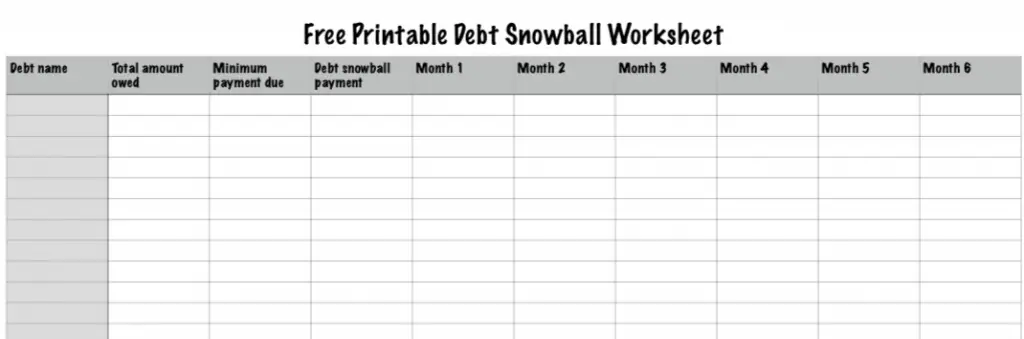
A debt snowball chart helps you manage your debt payoff method. Snowballing your debt means you take any additional money you have and put it towards paying off one of your accounts. You do this in order from smallest to largest amount owed. As you can see below, to organize this debt payoff method, you list the debts in order, along with the minimum payment due and your debt snowball payment.
<p>A debt snowball chart helps you manage your debt payoff method. Snowballing your debt means you take any additional money you have and put it towards paying off one of your accounts. You do this in order from smallest to largest amount owed. As you can see below, to organize this debt payoff method, you list the debts in order, along with the minimum payment due and your debt snowball payment.</p>::Pexels

Using this method of tracking can help you see how quickly you are making progress on your debt freedom journey and keep you motivated. Download an editable worksheet here or print a PDF version.
<p>If you think tracking the numbers might get boring for you, consider using a color-in debt free chart. You can print these online in various places and use them in various ways.</p>::Pexels

Color-In Debt Free Charts

If you think tracking the numbers might get boring for you, consider using a color-in debt free chart. You can print these online in various places and use them in various ways.


Savings Charts

While it isn’t a debt-free chart, per se, having a place to track your savings can be helpful too. There are a number of savings challenges on the internet that provide charts for helping you track your savings. Saving Advice is a hub of said challenges, including the 365-day money challenge, the 52-week savings challenge, and the 12-week savings challenge. Each of these can be tracked through a chart, like the debt snowball chart above, or you can use the color-in method to track your savings goals.

How to Create Your Own Debt Free Charts

Creating your own personalized debt freedom chart is fairly easy too. If none of the charts above suit your needs, simply follow these steps.

  1. Decide what your long-term goals are for your finances. Before you create a debt-free chart or any other finance tracker you’ll need to decide what you are tracking. Is it savings goals? Debt freedom goals? Investing goals?
  2. Determine how you want to break down the process. Then, once you know what you’d like to track, figure out how you are going to break it down. If you are tracking a debt-free goal, it may be best to track it by every $200 paid off (or whatever increment you decide).
  3. Figure out how you can stay motivated. If you know seeing the numbers will keep you motivated, consider something like the debt snowball chart above to track. Others may be more motivated by seeing a coloring sheet filled in. Whatever motivates you is what you should use.
  4. Start tracking. Once you decide on what will work best for you, start right away. You’ll put yourself that much closer to your financial goals by just biting the bullet and getting started.

No matter where you are in your journey, finding ways to stay motivated and track your progress is important. Consider printing out one or more of the debt-free charts above.

Readers, how do you track your progress? Share your ideas in the comments below!

Read More

  • November Update: Hustling to Pay Down Debt
  • When is Debt Settlement a Good Idea?
  • Should You Invest To Pay Off Debt?
  • A Checklist for a Strong Financial Plan

Filed Under: Debt Reduction Tagged With: charts to get out of debt, Debt Free Charts, debt free organization, printable charts, printable debt free charts

Creating A Personal Finance Calendar

March 21, 2024 | Leave a Comment

<p>I’ve come to the blog to talk about how we manage our money month-to-month before. I manage most of the money for our family, paying the bills and making sure we have cash where we need it when we need it. It’s not an easy task all the time, but it is well worth being able to live without scrounging paycheck to paycheck. However, I wouldn’t be able to do any of it without our personal finance calendar.</p>::Pexels

I’ve come to the blog to talk about how we manage our money month-to-month before. I manage most of the money for our family, paying the bills and making sure we have cash where we need it when we need it. It’s not an easy task all the time, but it is well worth being able to live without scrounging paycheck to paycheck. However, I wouldn’t be able to do any of it without our personal finance calendar.

When I started talking about my financial calendar to some of my friends, I realized I’m the only one taking this approach to money these days. For the most part, the people I talk to are plugged into some kind of app or tech solution that helps them keep an eye on their finances. While I’d love for that to be my life (so much less paper involved), it just doesn’t work for me. So, if you’re wondering about how you can create your own personal finance calendar, here’s how I organize mine.

What is a Personal Finance Calendar For?

A personal finance calendar will help you organize your financial life. Initially, I started using my PF calendar to get my budget down on paper. I marked down the days I’d go grocery shopping + the budgeted amount for the said shopping trip. I also jotted down the bills and what days they are due, plus the amount. Additionally, I added in the days we were getting paid and how much. Seeing everything written down on paper helped a lot.

That didn’t give me a full-picture view of my finances though. While it helped me pay my bills on time and stick to a budget, bigger expenses and other things tended to creep up on me. So, I decided to make some changes by adding bi-monthly, quarterly, bi-annual, and annual expenses to the calendar as well. This included things like car maintenance, property taxes, registration fees for the car, doctor’s bills, birthdays, holidays, vacations, celebrations, etc.

Going through and adding all of those things really made my financial calendar more well-rounded. It gave a full view of what we had going on, where our money is going, what we have planned, and what we are saving for.

Creating Your Own PF Calendar to Use

If you’re interested in creating your own personal finance calendar, it’s fairly easy. First, you need to gather a few things…

  1. Get a planner or a calendar to write down the necessary financial information . This doesn’t need to be fancy. You can get one at the Dollar Tree or Family Dollar!
  2. Scrap paper for lists, etc. is also a good idea. You will want to list out monthly expenses as well as other costs throughout the year before they go into your personal finance calendar.
  3. Buying a nice pen to write with might make a difference. I just love writing with a good pen. It makes me feel organized.
  4. Stickers and fun items can make the process more fun. You may even find some that correlate to your bills. For instance, we have “payday” stickers for the days we get paid.

Once you have what you need, it is time to start organizing your calendar. The first thing you want to write down is all of your expenses that remain the same month-to-month. For instance, we pay $1,767.50 in rent every month. That will not change until the end of the year when we renew our lease or move. The number $1,767.50 is written down along with “RENT” on the 1st day of every month. Similarly, our car payment of $698 is written down on the 14th of every month. Until we get it refinanced, this is the static monthly cost.

Once that is complete, start listing the expenses that may vary in cost each month. For example, you have to pay utilities on a monthly basis. However, our electric bill goes up in the summer due to running the air conditioning. In the winter, the gas bill is higher. Make an estimate for how much you’ll spend on these items (it’s a good idea to round up).

Following the addition of those costs, you can start adding in the less frequent expenses. For us, this includes our annual registration fees for our car, property tax on the vehicle, car maintenance, paying our taxes, renewing annual subscriptions, celebrating birthdays, holidays and vacations, and ensuring we have enough money to pay for annual check-ups.

That’s it – once you’ve jotted down all of the financial “things,” you have a reference point for managing your money throughout the rest of the year.

Readers, how do you stay on top of your finances? Do you use a personal finance calendar or other methods of organization? 

Read More

  • Getting Ready For Tax Day
  • Confession: We’ve Taken On A Little More Debt
  • Valentine’s Day: Money and Marriage Reflection
  • How Much Money Do You Need To Put Down On A Home?

Filed Under: Budgeting Tagged With: budget calendar, debt free organization, how to organize your money

  • Email
  • Facebook
  • Pinterest
  • Twitter

Our Most Popular Articles

ClickCashGo Review: Should You Avoid At All Costs?

Ultimate Guide to Mastering Your Credit Score

The 'YOLO' Mindset is a Dangerous Thing

Dave Ramsey's Financial Peace University Review: Is it Worth the Money?

Cash App Glitch 2025: Is the Free Money Glitch Real?

Five Steps To Debt Freedom

Here are five simple guidlines that will help you pay off debt.  

1) Get an emergency fund so you don’t take on debt when something comes up.

2) List your debts. This way you know where you stand.

3) Use the debt snowball. Pay your debts from smallest to largest, or most expensive to least expensive.

4) Avoid new debt. No new credit cards or loans. Period.

5) Go all cash. After everything is paid off, switch to all cash.

Helpful Resources

The Free Checklist for a Strong Financial Plan

U of Tennesse Debt Repayment Plan Basics

Vertex 42's Debt Payoff Calculator

Savingadvice's Helpful Debt Forums

Jackie Becks Debt Blog