Our Debt Free Family

Commit. Plan. Take action.

  • BUDGETING
  • DEBT REDUCTION
  • INVESTING
  • LIFESTYLE
  • TOOLS
  • ABOUT
  • Privacy Policy
  • CONTACT

What is a Scottish Trust Deed?

December 29, 2023 | Leave a Comment

<p>What is a Scottish Trust Deed?</p>::Pexels

As the name suggests, a Scottish Trust Deed only applies to residents of Scotland and is a voluntary arrangement made between you and your creditors.

Under the terms of a Scottish Trust Deed you can make a proposal to repay your debts over a set period of time and therefore avoid bankruptcy (or ‘sequestration’ as it’s otherwise referred to).  If any debts remain outstanding at the end of the arrangement then they’ll be written off and you won’t have to repay them.

How does a Scottish Trust Deed work?

If you choose to enter into a Trust Deed then all your assets will be passed over to your Trustee.  He or she will then take full control of the arrangement and will endeavor to pay back as much debt as possible.  In order to achieve this some of your assets might be sold – for example, any personal belongings or property you might own.

Will I have to liaise with creditors myself?

No.  By entering into a Trust Deed you’ll no longer have to worry about making contact with your creditors.  Any correspondence or discussions with them will be done by your advisor, who will then continue to liaise with them throughout the arrangement.  All you’ll be expected to do is to make the monthly repayment to your advisor/trustee on time and then you can simply leave the rest to them.

How much will I have to repay?

When you first enquire about entering into a Scottish Trust Deed your chosen advisor will conduct an initial ‘fact find’.  This enables him or her to fully understand your financial situation and to work out how much you’ll be able to repay to your creditors on a monthly basis.  In making this assessment your advisor will ensure you have enough money left over to ensure that any debts which can’t be included are capable of being repaid through a separate repayment plan.  The main priority is that your repayments are affordable – especially if you enter into a protected Trust Deed, which is legally binding on all parties.

What’s the difference between a ‘protected’ deed and an ‘unprotected’ deed?

If the vast majority of your creditors agree to the proposal you’ve put forward then the trust deed is likely to be ‘protected’.  This means that the arrangement becomes legally binding and your creditors won’t be able to pursue you either during, or after, the arrangement to claim further money from you.

If, on the other hand, the deed isn’t protected then it’s not legally binding and you may still be pursued for any residual amounts once the arrangement ends.

How much will it cost?

You should ask your advisor for details of the cost before you enter into a Trust Deed as they can be very expensive.  However, the cost of it can usually be repaid as part of your monthly repayments so that you don’t have to find the arrangement fee up front.  However, if you have any concerns about the cost you should speak to your advisor.
Filed Under: Budgeting

How to Succeed at the 365 Day Money Challenge

December 29, 2023 | Leave a Comment

365 day money challenge

Several years ago, online challenges became really popular. Individuals challenged one another online to do 100 squats a day, lose weight, write journals, and save money. Of these challenges, one of the most popular has been the 365 Day Money Challenge. This was a finance-focused challenge that helped people save a set amount of money throughout the span of a year. 

About Money Challenges

If you’ve never heard of a money challenge, don’t worry! They are fairly simple to understand and extremely easy to participate in. The 365-day money challenge helps you save $668 over the span of a year, one penny at a time. Depending on your savings goals, you can pick-and-choose between many different money challenges that have higher (or lower) savings goals.

Other challenges also have altered time spans as well. For instance, there is the 26-week money challenge, or the bi-weekly money challenge, that helps individuals put money away every other week. No matter what your goals are, there is a money challenge out there for you.

The 365 Day Money Challenge

The money challenge was one of the first to appear online. Essentially, you start with saving $0.01 on the first day, $0.02 on the second day, $0.03 on the third day, and so on. On the 365th day, or after one year, you will have accumulated nearly $670.

One problem with challenges, however, is that many people fail to complete them. Maybe they grow bored with it or they don’t have a plan in place for saving. Whatever the case may be, follow these tips to successfully perform the challenge:

  1. Print this sheet to track your 365-day money challenge progress. Tracking your savings will help encourage you to continue on. You’ll be able to see the money stacking up over time. Also, writing your contributions down will help make you feel like you are being held accountable for saving that money.
  2. Join a Facebook Group. The 365-day money challenge has been around for a few years and thousands of people have tried it out. There are plenty of forums and social media groups to talk about the money challenge, ask for help, and bounce ideas off other individuals. Having support like this can encourage you to continue saving and complete the challenge.
  3. Ask a friend to join you. By asking someone you know to join you in the challenge, you can create a small feeling of competition, making the challenge more interesting. It can also provide you with someone to go to if you are having trouble saving or sticking to your plan.
  4. Keep your eye on the prize. Whatever the reason is for you want to take on the 365-day money challenge, write it down on a sticky note and put it wherever you are stashing your pennies every day. Seeing that reminder will help you continue driving forward with your savings goals.

No matter what those goals are, participating in a challenge like the 365-day money challenge is a great way to add to or kickstart your savings. Making the decision to take on a year-long challenge is a big commitment but can prove to be extremely beneficial.

Have you tried a money challenge? How much did you save?

Read More

  • Do People Still Cut Credit Cards?
  • What Are The Biggest Things People Struggle With Paying Off Debt?
  • The Quest for Cheaper Housing
  • Why Did No One Tell Us Adulting Was This Hard?

Filed Under: Budgeting Tagged With: 365 Day Money Challenge, money challenge

8 of the Best No Credit Check Loans to Apply for Now

December 29, 2023 | Leave a Comment

<p>best no credit check loans</p>::Pexels

Approved loan application form lay down on wooden desk with rubber stamp and calculator.

Strapped for cash? A lot of us need the money to get by. The problem is many of us also have bad financial scores. Almost a third of Americans have scores below 601, which is the line between fair credit and bad credit.

Even then, you need the money, so you still need that loan. What do you do? Go for no credit check loans.

You can’t go out there without knowing which one’s right for you. You need the best loans with no credit check, but which one?

In this article, we’ll choose the eight of the best no credit check loans you can apply for now. This will give you the choices you need.

1. Payday Loans

The payday loan is one of the most basic cash loans out there. They come in a variety of types, but they have some common characteristics. Your generic payday loan can have one of the following:

  • Short payment scheme
  • 24-hour approval
  • Zero credit checks
  • Small on-time payment interest

If you’re short on cash, all you need is your ID and proof of stable income. The payment scheme for this loan type should be around 30 days, hence the name. You would need to pay for these no credit check personal loans on time, however.

Forgetting to pay on time can incur large penalties. Your interest rates can go as much as 400 percent on a late payment. If you think you need more details about payday loans, here’s how you can learn more.

2. Personal Loans

Personal loans are the opposite of payday loans. Much like the payday loan, no credit check personal loans have minimal requirements. These are great if you need a quick cash influx but don’t have enough money to pay in a single month.

Not all lenders omit the credit check, but there’s a lot that do. This means there are fewer hindrances and more chances for approval. These can provide for something as low as a hundred dollars to around a thousand dollars at most.

The structure of this loan type lets you pay within a few months without having to fork over all your money from your salary, which goes as short as 60 days up to 2 years for some providers.

3. No Credit Check Quick Loans

Quick loans are another variety of the no credit check loans in the market. Like its name, this type of loan provides the fastest approval and cash disbursement among all loans.

Quick loans need no collateral and dispense money as soon as possible. This is the best option if you’re a little bit on the short end but can pay for it soon, and since they don’t care about your FICO score, you don’t have to worry.

If you need some quick money and you’re willing to pay ASAP, then this is what you need for no credit check personal loans.

4. Bad Credit Student Loans

It’s hard to get student loans on the normal credit market. It’s harder, however, to get one on bad credit. Bad credit student loans are a great solution to this problem.

The bad credit student loan exists to help poor but hardworking individuals get financing for their studies, with a flexible student loan amount covering as little or as much as you need.

Need some extra money for textbooks? Get the best loans with no credit check for as low as $100.

Need to pay for your tuition? You can borrow as much as $15,000 with minimal fees. Payment is similar to personal loans no credit check type of requests, so you can structure the right payment scheme for you.

5. Online Installment Plans

Online installment loans are a type of no credit check loans that let you borrow money if you can show two things. These are:

  • An ability to repay
  • A US Bank account

From here, they will transfer the money straight into your account after a few quick hoops. The transfer time goes at around one business day, with the approval period being either instant or a few minutes long.

An online installment plan has a standard payment scheme. This means you are losing a bit of flexibility on how long you can pay. If you need a fast and hassle-free way to get a loan, however, this is the option for you.

6. Title Loans

Title loans are some of the minor collateral type loans in this list. Like all the lending programs in this list, this is in the personal loans no credit check variety.

Title loans tend to use small possessions as a sort of collateral. Most customers of the service use their cars as collateral because it’s quick to access and transfer.

This is one of the riskier types of loans around. It also belongs, however, to the loans with the lowest APR and best payment flexibility for you.

7. Mortgage Loans

The mortgage loan is one of the longest term loans in this list, and for a reason. This is one of the best loans with no credit check available for anyone who has a bad credit score.

The specifics of this loan includes long-term payment structures with large payout schemes. You can do this loan type if you’re a bit short for your house fees. It’s also best for people who want to pay off their mortgage early.

8. Small Personal Loans

Small personal loans are a variant of the personal loan. It has several key features, which makes it a good option for people who don’t need more than a small influx.

These features include:

  • Small principals starting at $500
  • Quick installments, quick repayments
  • Zero collateral
  • 1 – 2-day cash delivery

The good thing about small personal loans is they have lower interest rates than payday loans, so this no credit check loan is worth it.

Finding the Best No Credit Check Loans for You

If you are looking for a quick injection of cash, it’s smart to find the best no credit check loans out there. Before signing anything, make sure to read the terms and conditions. See what kind of financing structure is best for you.

Why do we care so much about your money? It’s because we’re all family, and it’s great if you are a part of Our Debt Free Family.

Our Debt Free Family is there to help you learn how to take care of your money matters. Whether you need a loan or want to control your spending, we can teach you how to get there.

Why not hack your way into debt and investing? We can teach you how to do it easy, so you can be part of Our Debt Free Family.

Filed Under: Budgeting

Update: Settling Into Our New Home

December 29, 2023 | Leave a Comment

<p>There has not been a lot of time to stop and reflect on financial or life updates for the blog recently. We have been running around like crazy for about four weeks now preparing for a move, moving, and settling in. Finally, we are starting to have what resembles home and a new routine for our family. Here's how we are settling into our new home.</p>::Pexels

There has not been a lot of time to stop and reflect on financial or life updates for the blog recently. We have been running around like crazy for about four weeks now preparing for a move, moving, and settling in. Finally, we are starting to have what resembles home and a new routine for our family. Here’s how we are settling into our new home.

Goodbye, Atlanta!

<p>I met some truly fantastic people in Atlanta, but living there was not good for my mental health, my marriage, or my relationships with others. My husband and I started looking at homes to rent closer to our original homes again (back to North Carolina). A few weeks into our search, we decided we would probably wait until March to move so that we could be financially prepared. No more going into debt just to improve our immediate circumstances, right?</p>::Pexels

I met some truly fantastic people in Atlanta, but living there was not good for my mental health, my marriage, or my relationships with others. My husband and I started looking at homes to rent closer to our original homes again (back to North Carolina). A few weeks into our search, we decided we would probably wait until March to move so that we could be financially prepared. No more going into debt just to improve our immediate circumstances, right?

Well, the universe had different things planned.

Our tiny 450-square foot apartment got bed bugs (again – the second time in two years). Thinking about having to deal with an exterminator coming in, finding a place to go during COVID, and the multitude of other concerns on my plate, I was pretty close to having a mental breakdown. I didn’t even want to be in Atlanta anymore, why were we fighting so hard to stay?

A few things crossed my mind. “Just abandon the lease, there are bed bugs in the apartment.” “We can sleep on an air mattress for a few weeks.” “We have to call the landlord.” “Oh, God, we are in no way financially prepared for this right now.”

Help From Mom

I started talking to my mom about what was going on. She was there throughout the first ordeal with bed bugs. I just needed to vent to someone, but she offered to help pay for us to move out immediately. Who could turn that down? So, we started looking for a new home as if “money weren’t an issue,” as mom said.

Within a couple of days, we found a cute three-bedroom and two-bath house close to where my husband and I grew up. We were approved within a couple of hours of applying and mom helped with all of the deposits, moving truck, and other moving essentials. Just like that, our lives completely changed (and for the better).

The move, in general, has been an immediate improvement in the quality of life for us. We are happier, there is more space, we can see people we love. More importantly, we have so many things to keep us busy.

Shopping and Gifts

We did not bring a single piece of furniture from our apartment in Atlanta. There was no use in risking us bringing bed bugs into our new home. So, instead, we started saving every penny we could to get some small essential things (i.e. a cheaper mattress, living furniture, new towels, etc). We have furnished the house (pretty much) for under $2,000 out of pocket.

Amazon has some great buys as far as mattresses go. We grabbed our 10″ mattress for about $300. My grandmother had a box spring she did not need that we got for free. We also got a side table for the bedroom for free. The living room furniture took some more digging. We spent $300 on a futon and ottoman for the living space and used our old coffee table, TV stand, and television.

<p>Amazon has some great buys as far as mattresses go. We grabbed our 10" mattress for about $300. My grandmother had a box spring she did not need that we got for free. We also got a side table for the bedroom for free. The living room furniture took some more digging. We spent $300 on a futon and ottoman for the living space and used our old coffee table, TV stand, and television.</p>::Pexels <p>Amazon has some great buys as far as mattresses go. We grabbed our 10" mattress for about $300. My grandmother had a box spring she did not need that we got for free. We also got a side table for the bedroom for free. The living room furniture took some more digging. We spent $300 on a futon and ottoman for the living space and used our old coffee table, TV stand, and television.</p>::Pexels

A family friend came by with a glass dining table, four chairs, and two barstools. These were a gift. They need to be reupholstered, but that will only cost about $100 to $120 in total. That isn’t too bad for a dining set and stools. Then, last, but not least, my mom bought us a refurbished washer and dryer set ($750 with delivery and installation).

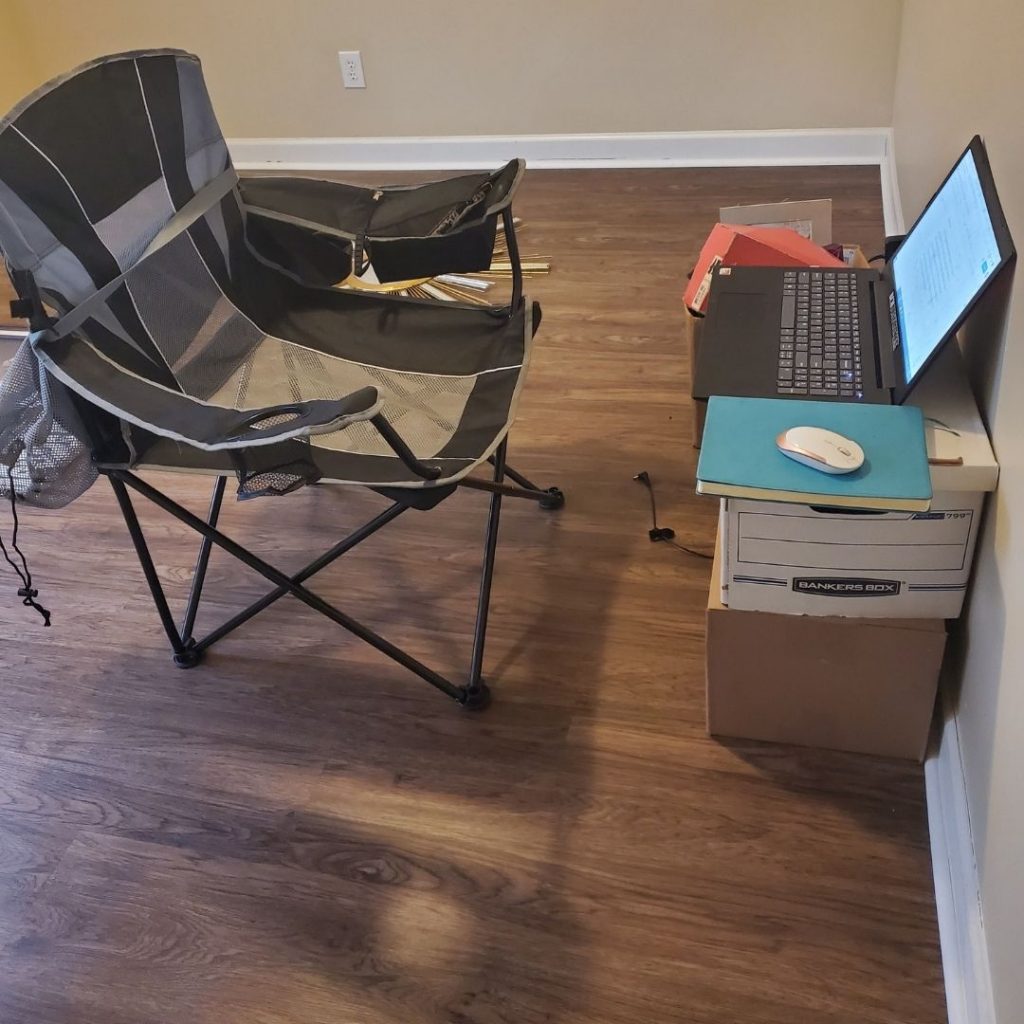
<p>Today, a new desk arrived for my new office space ( on Amazon). A new office chair will arrive within a couple of weeks. By February, a beautiful sectional my grandmother purchased as a gift will be here.</p>::Pexels

Today, a new desk arrived for my new office space ($65 on Amazon). A new office chair will arrive within a couple of weeks. By February, a beautiful sectional my grandmother purchased as a gift will be here.

Making This Our ‘New Normal’

Overall, as I sit curled up on my futon which will eventually be in my spare room, I can’t help but think about how very blessed we have been. There is no doubt this year has been hard for everyone, but I am feeling hopeful. It is hard to settle into this space when it feels like there is so much to do – so much to straighten up, so much to organize, so much to decorate – but it is already home.

In the mornings, we open the back door and the dog goes into our new backyard. We have a cup of coffee together, then I go into my make-shift office (photo for the laughs).

<p>In the mornings, we open the back door and the dog goes into our new backyard. We have a cup of coffee together, then I go into my make-shift office (photo for the laughs).</p>::Pexels

We are beginning to have what we never did in Atlanta: a routine. Eventually, this little place will fill up with things that depict our character. Memories will flood the hallways and we will make a wonderful life here. For now, there is still a little bit of settling to be done.

Read More

  • How to Succeed at the 365 Day Money Challenge
  • Do People Still Cut Credit Cards?
  • What Are The Biggest Things People Struggle With Paying Off Debt?
  • The Quest for Cheaper Housing

Filed Under: Budgeting

Debt Snowball vs. Debt Avalanche: Which is a Better Approach to Paying Off Debt?

December 29, 2023 | Leave a Comment

<p>There is no sure-fire way to handle your finances or handle paying off debt. Each situation requires a different approach, depending on your personal financial needs. So, when it comes to being debt-free, what is the best way to handle paying off your accounts? How do you decide between a debt snowball vs. debt avalanche?</p>::Pexels

There is no sure-fire way to handle your finances or handle paying off debt. Each situation requires a different approach, depending on your personal financial needs. So, when it comes to being debt-free, what is the best way to handle paying off your accounts? How do you decide between a debt snowball vs. debt avalanche?

Debt Snowball vs. Debt Avalanche

“Debt snowball” and “debt avalanche” refer to two ways you can choose to pay down your debt. Deciding which method is best for you depends on your own personal situation. However, there are pros and cons to both approaches. Here’s what you need to know.

The Debt Snowball

Snowballing your debt is a great way to pay off your accounts in a quick fashion. To use this approach you need to begin paying off your debt in order of smallest to largest. So, if you have three accounts that need to be paid with amounts of $1,450, $6,578, and $10,755, you’d start paying as much as you can on the $1,450 account. Pay the minimums on the other two until you pay the first (smallest) account off. Once you’ve paid that account, move on to the $6,578 debt, then the $10,755.

Perks of using this method are being able to see your debt is paid off in a quick fashion. It provides a feeling of accomplishment and helps keep you motivated. You’ll also be able to free up more funds as you pay off the smaller accounts to tackle your other debt.

When it comes to comparing the debt snowball vs. debt avalanche, one con of the snowball may be that you wind up paying more in interest over time. It may also take longer to pay off your debt this way. However, it is a tried-and-true method.

The Debt Avalanche

Using a debt avalanche is another great way to pay off your debt over time. Instead of paying down debt by the total amount owed, you pay it off by the interest rate. So, if the three accounts mentioned above had interest rates of 7.9%, 9%, and 12%, then you’d want to start throwing money at the $10,755 account with the 12% interest rate first.

The biggest perk of this type of debt payoff plan is you’ll pay less interest in the long-run. You may also find that a debt avalanche approach helps you pay your debt off faster than the debt snowball approach. However, it can be harder to maintain your motivation with the avalanche method. It can also feel like it takes a longer time to pay things down.

Choosing the Best Approach For You

When it comes down to choosing between a debt snowball vs. debt avalanche approach, both will help you meet your goal of being debt-free if you stick to it. The best way to choose which is right for you will depend on your personal goals and what keeps you motivated.

If you think you’d lose motivation with the avalanche method, maybe you should try snowballing your debt first. Or maybe the thought of saving money on interest will keep you pushing forward on paying off your debt. If that’s the case, try out a debt avalanche instead.

You also don’t have to choose one or the other. Sometimes the best approach to paying off your debt is a combination of the two. Deciding what will motivate you and help you reach your debt-free goal is most important.

Have you tried either one of these debt payoff approaches?

Read More

  • Creating Your Payoff Plan – The Debt Snowball
  • If You Want to Save More, Try This 12-Week Challenge
  • Have You Tried The 52-Week Money Challenge?
  • Are You Ready For a Financial Challenge?

Filed Under: Budgeting

Debt and the Holidays: An American Story

December 29, 2023 | Leave a Comment

<p>Are you someone who goes into debt every holiday season? You're not alone. Debt and the holidays go hand-in-hand with one another for many families. Many people spend more than they have or money they simply don't have to fund the holiday season (i.e. gifts, a Christmas tree, cards, dinners, treats). However, they don't consider the lasting impact on your finances throughout the rest of the year.</p>::Pexels

Are you someone who goes into debt every holiday season? You’re not alone. Debt and the holidays go hand-in-hand with one another for many families. Many people spend more than they have or money they simply don’t have to fund the holiday season (i.e. gifts, a Christmas tree, cards, dinners, treats). However, they don’t consider the lasting impact on your finances throughout the rest of the year.

Debt and the Holidays: A Story

Growing up, I was good friends with a larger family that was fairly well-off. Each year around Christmas, their mother took out a loan to pay for gifts for the kids. Yes, a LOAN. It sounded insane to me then and it still sounds fairly crazy to me now, but I realized more people do this than you might realize.

Every single year, they would have new Michael Jordan sneakers under the tree, a new phone, a new iPod, and literally whatever they asked for. In my family, we always had a nice Christmas, but within reason. When I would visit and see how they celebrated, it would always blow my mind. To me, it didn’t feel much like Christmas. It felt more like they were showing off for someone. But who?

I’m not sure if that is true or not, but it is certainly how it felt. Once I learned a loan was taken out for it each year, my jaw dropped. How did that make any sense at all? Then it was explained to me that they would pay it off before the next year’s celebration. While, in theory, this could work and even benefit your credit score, I’d still avoid it like the plague.

Why This is Generally a Bad Idea

Of course, if you have the means to pay off the loan in a short period of time like they did, great. But wouldn’t it be even better if you used that money and put it into savings each year? Your savings can accrue interest, while your loan’s interest isn’t the desirable sort.

On top of potentially putting yourself in a hard spot financially, it is also supporting bad habits with your money. When you take out a loan to cover Christmas gifts, you are giving yourself the “okay” to do it with other things too. Before you know it, you have tens of thousands of dollars in credit card debt and need a loan to be able to pay for rent, not just gifts once a year.

So, before you go over the top and think about getting a loan out or going into debt over the holidays, think about how you can better budget your money, save, and give meaningful gifts. After all, the true meaning of the entire season is the spirit of giving – that doesn’t mean you need to spend a fortune.

Readers, what do you think about debt and the holidays? Have you ever considered getting a loan out for Christmas or any celebration?

Read More

  • Update: Settling Into Our New Home
  • How to Succeed at the 365 Day Money Challenge
  • Do People Still Cut Credit Cards?
  • The Quest for Cheaper Housing

Filed Under: Budgeting Tagged With: christmas spending, debt and the holidays

How to Audit Your Home Energy Usage

December 29, 2023 | Leave a Comment

p>One of my favorite things about fall is that it presents the opportunity to save money on your home energy costs. You can open windows to cool the house down and can usually use methods indoors to avoid kicking the heat on. However, before you try to start saving money on your home energy costs, you may want to perform a home energy audit to get an idea of how energy efficient your house is.</p>::Pexels

One of my favorite things about fall is that it presents the opportunity to save money on your home energy costs. You can open windows to cool the house down and can usually use methods indoors to avoid kicking the heat on. However, before you try to start saving money on your home energy costs, you may want to perform a home energy audit to get an idea of how energy efficient your house is.

How to Audit Your Home Energy Usage 

Performing a home energy audit sounds a lot more difficult than it actually is. There are a few things you can check and fix yourself to get your home ready for the colder months.

Locate Leaks (water and air)

Reducing drafts in your home can reduce your home energy cost by 10% to 20% each year. To check for “air leaks” or drafts, ensure that your baseboards are secure and without holes. You should also check for cracks at the junctures of ceilings and walls. You can also check windows, doors, fixtures, switches and electrical outlets. If you have a fireplace, you’ll want to check that for dampers as well.

Check Your Insulation

In older homes especially, insulation can need to be replaced. Replacing insulation in your home could greatly reduce your home energy cost over the winter by reducing the amount of time your heat is running. Having better insulation will improve your home’s ability to maintain temperature without any additional energy. Don’t forget to also check attic spaces and crawlspaces to determine whether added insulation in those places will help your home energy cost. Read why you shouldn’t continuously adjust the thermostat. 

Inspect Your Heating and Cooling System

Like many other household appliances, your furnace and air conditioner get old and break. As those appliances get older, they can also lose their energy efficiency. If your unit is 15 years old or more, you should consider replacing it to maximize efficiency and reduce energy cost in your home. Additionally, if your unit is nearing its 15th year, start saving for a new unit!

Change Out Your Bulbs

A few years ago, everyone was switching to LED bulbs to save money on energy costs at home.  If you decide to switch your bulbs to energy efficient bulbs it can save you a ton of money. Lighting accounts for about 10% of your overall electric bill so switching to LED can actually make a difference.

Inspect Other Appliances

Like your heating and cooling system, other appliances in your home get old and need to be replaced. An old refrigerator, for instance, may cost more to run than a newer model. The newer model of dishwashers, toilets, and showerheads tend to use less water and, therefore, cost less to run/maintain. Consider replacing your old, outdated appliances with new, energy-efficient appliances. This can prove to help you reduce your energy use month-to-month significantly.

These are just a few of the ways you can audit your home to make it more energy efficient. If you’re unsure of your ability to check these things, you may want to hire a handyman to take a look around and give you an idea of what your home energy usage report card looks like. Either way, making the changes necessary to transform your home into an energy efficient one will prove to be beneficial for your wallet.

See something we left out of the home energy usage audit? Comment below!

Photo: Chuck Coker

Filed Under: Budgeting Tagged With: energy efficient, energy usage, home energy, home energy audit

Great Ways to Save Money During the Holidays

December 29, 2023 | Leave a Comment

<p>It’s no surprise that for many American families, the holidays can be a huge financial stretch. That stretch and stress can put a huge burden that may take months to pay off. That stress can be damaging financially and emotionally. This blog post is a compilation of simple ways to prevent the holidays from becoming a negative emotional weight on your family!</p>::Pexels

It’s no surprise that for many American families, the holidays can be a huge financial stretch. That stretch and stress can put a huge burden that may take months to pay off. That stress can be damaging financially and emotionally. This blog post is a compilation of simple ways to prevent the holidays from becoming a negative emotional weight on your family!

[Read more…]

Filed Under: Budgeting

How I’m Throwing A Cookie Decorating Party on a Budget

December 29, 2023 | Leave a Comment

How to throw a cookie decorating party Pinterest graphic

Every Christmas, I throw a cookie decorating party. Generally, I have a few of my friends here, along with their children, and we decorate cookies, do Christmas crafts, listen to music, and watch movies. As you can imagine, this kind of get-together can get costly fast. You have cookies, icing, decorating tools, a table cover, food, etc. However, I never break my budget when it comes to throwing this party. Here’s how I’m doing it.

Go To Aldi

Aldi has the best prices around where groceries are concerned, there’s no doubt about that. Sometimes heading to Aldi isn’t as convenient for me, but if I’m throwing a get-together, I ALWAYS head there. For this party, I’ll be making a couple of grazing boards to snack from. Things like salami, pepperoni, veggies, fruit, and cheese are all reasonably priced at Aldi.

I’m also going to snag everything I can for the cookie making at Aldi (flour, sugar, baking soda, confectioner’s sugar, etc.). Again, things are just cheaper there.

Hit the Dollar Store

The next store on my list to hit for the party is the Dollar Store. There are a few things I will pick up as party favors and other craft materials there. Many Dollar Stores have fun Christmas mugs throughout the holiday season. Everyone attending the party will get one to put their hot chocolate in and they can take it home. For $1, that’s a steal and a great little party favor!

They also have ornaments that we will paint. Again $1 for a set of ornaments to decorate is a steal. I’ll also grab other things like a table cover to protect my table during the decorating, a pack of festive plates, and a little candy to go into their gift bags. We also do small gifts (under $20), so I’ll grab a couple gift bags too.

Planning for Cost

The biggest thing about throwing a cookie decorating party, or any kind of gathering, is knowing what your budget is ahead of time. Know exactly how much money you want to spend or are willing to spend on the event. Pinterest is a great place to find DIY and budget-friendly dupes and ideas.

All of that said, having a decorating party like this has become a great tradition for us. It is somewhere between Friendsgiving and Christmas – and we love it. Even if it’s fancier some years than it is others, it is something we can always look forward to. Whether we spend $20 or $100, it is something we can enjoy every year.

To me, that is the best part of it all – I could buy a package of pre-made sugar cookies and icing and we’d still be able to carry on with this tradition.

Readers, what are some of your holiday traditions and how do you plan to cover the cost each year? Let me know your thoughts in the comments below! 

Read More

  • Money and Holidays: Remembering the Reason for the Season
  • How to Practice Mindful Spending During the Holidays
  • How Inflation Will Impact Our Holiday Plans
  • Financial Update: November 2022

Filed Under: Budgeting Tagged With: holiday season, holidays, how to financially prepare for the holidays, prepare for the holiday season

Happy Holidays! Here Are Our New Year’s Resolutions

December 29, 2023 | Leave a Comment

<p>Christmas was extremely successful in our home this year. We managed to keep everything low-cost where presents were concerned. However, many of them haven't gotten in the mail for our relatives out of town (whoops). Christmas Day we went to the dog park with our baby (Enzo) and made homemade lo mein instead of ordering takeout Chinese. We ended the holiday looking forward to creating a vision board for 2019 and setting some New Year's resolutions.</p>::Pexels

Christmas was extremely successful in our home this year. We managed to keep everything low-cost where presents were concerned. However, many of them haven’t gotten in the mail for our relatives out of town (whoops). Christmas Day we went to the dog park with our baby (Enzo) and made homemade lo mein instead of ordering takeout Chinese. We ended the holiday looking forward to creating a vision board for 2019 and setting some New Year’s resolutions.

Setting Family New Year’s Resolutions

My other half and I have a lot of goals for 2019. This year will be our first year creating a Vision Board together. It will include financial goals, of course, and personal goals for us both. On the personal side of things, we would both like to get married next year. I would also like to train for and run a 5K and lose the last 40 pounds I have to reach my weight goal.

Financially, we both have the same long-term goal: be debt-free. However, to hone in on what we need to do in 2019, we’ve made a list of our debts and plan to snowball it starting January 1. Here’s what we’ve discussed so far…

  1. Pay off “small” debts by March. The other half’s car will be paid off by March. We will also have our credit cards paid off by then and a small medical bill ($242). Having these things paid off in full will leave us room to pay off other debts, including new tax debt.
  2. Focus on tax debt while making minimum payments on other accounts. We owe a little over $9,000 and have established a payment plan with the IRS. With my other half out of work last year, we weren’t able to put taxes aside as we normally do. After we pay down the smaller accounts, we will use all of our extra cash to pay this off. Once it is paid we are also going to begin putting big chunks of cash aside for future tax bills.
  3. After tax debts are paid, we will be making extra payments on remaining accounts. Once the IRS is paid, we will start throwing extra cash at the remaining accounts. We will still have our Conn’s bill (about $2,000 remaining), student loan ($22K), car loan ($20K), and the tool bill ($10K).

Creating a Vision

New Year’s resolutions are overrated for the most part. Many people abandon them by the end of March. For us, creating a Vision Board is more important than resolving to change in the new year. Instead, we are focused on large goals we’d like to reach by the end of the year. Each of the steps above will be part of reaching that vision and creating a life we want to live.

What about you? What are your New Year’s resolutions? Do you create a Vision Board?

Read More

  • Debt Resolutions for 2019: Making a List and Checking It Twice
  • Debt Snowball vs Debt Avalanche: Which is Better?
  • What is the Worst Piece of Financial Advice You’ve Ever Received?
  • If You Want to Save More in 2019, Try This 12-Week Challenge

Filed Under: Budgeting Tagged With: financial resolutions, new year's resolutions, vision board

  • « Previous Page
  • 1
  • …
  • 27
  • 28
  • 29
  • 30
  • 31
  • …
  • 50
  • Next Page »
  • Email
  • Facebook
  • Pinterest
  • Twitter

Our Most Popular Articles

ClickCashGo Review: Should You Avoid At All Costs?

Ultimate Guide to Mastering Your Credit Score

The 'YOLO' Mindset is a Dangerous Thing

Dave Ramsey's Financial Peace University Review: Is it Worth the Money?

Cash App Glitch 2025: Is the Free Money Glitch Real?

Five Steps To Debt Freedom

Here are five simple guidlines that will help you pay off debt.  

1) Get an emergency fund so you don’t take on debt when something comes up.

2) List your debts. This way you know where you stand.

3) Use the debt snowball. Pay your debts from smallest to largest, or most expensive to least expensive.

4) Avoid new debt. No new credit cards or loans. Period.

5) Go all cash. After everything is paid off, switch to all cash.

Helpful Resources

U of Tennesse Debt Repayment Plan Basics

Vertex 42's Debt Payoff Calculator

Savingadvice's Helpful Debt Forums

Jackie Becks Debt Blog