Our Debt Free Family

Commit. Plan. Take action.

  • BUDGETING
  • DEBT REDUCTION
  • INVESTING
  • LIFESTYLE
  • TOOLS
  • ABOUT
  • Privacy Policy
  • CONTACT

Sell Your Stuff and Other Creative Ways to Boost Your Income

February 14, 2024 | Leave a Comment

These past couple of weeks, we’ve been talking about saving money to help you reach your financial goals. I shared 48 ideas to help you cut expenses and trim your spending.

Today, let’s dive in to brainstorming ways to boost your income.
[Read more…]

Filed Under: Budgeting

What Do You Do When You’ve Have a Great Year?

February 14, 2024 | Leave a Comment

<p>It is that time of year again where many of your friends and family will resolve to change themselves for the better. The “new year, new me” vibe isn’t anything new. In fact, many people have become cynical of resolutions altogether. While I see how that could be easy to do, resolving to better yourself, or setting goals, is extremely helpful in life, both financially and personally. At the beginning of 2017, just one year ago, I resolved to better myself physically and financially. My credit score was around 420, I was living in a motel, and I was seriously overweight (around 280 pounds). I was spinning my wheels and needed to make a change. By February, I’d paid off the biggest piece of debt keeping me from being able to move and in April we leased an apartment. Then I started focusing on my health and continuing on my current financial path. I continued to pay off debt and started to save money. In June, I had to use all my newfound savings for a medical emergency (doesn’t that always happen?). No matter what happened, I continued to push forward. Skip to December 31, 2017, and my credit score is sitting at 650 (much better than earlier in the year). I’m also down 106 total from two years ago, 74 of which was lost in 2017. I also managed to establish some savings and established some credit for myself. When entering 2018 I was kind of flabbergasted. What do you do when you come off a good year? How do you maintain momentum?</p>::Pexels
It is that time of year again where many of your friends and family will resolve to change themselves for the better. The “new year, new me” vibe isn’t anything new. In fact, many people have become cynical of resolutions altogether. While I see how that could be easy to do, resolving to better yourself, or setting goals, is extremely helpful in life, both financially and personally.

At the beginning of 2017, just one year ago, I resolved to better myself physically and financially. My credit score was around 420, I was living in a motel, and I was seriously overweight (around 280 pounds). I was spinning my wheels and needed to make a change.

By February, I’d paid off the biggest piece of debt keeping me from being able to move and in April we leased an apartment. Then I started focusing on my health and continuing on my current financial path. I continued to pay off debt and started to save money. In June, I had to use all my newfound savings for a medical emergency (doesn’t that always happen?). No matter what happened, I continued to push forward.

Skip to December 31, 2017, and my credit score is sitting at 650 (much better than earlier in the year). I’m also down 106 total from two years ago, 74 of which was lost in 2017. I also managed to establish some savings and established some credit for myself.

When entering 2018 I was kind of flabbergasted. What do you do when you come off a good year? How do you maintain momentum?

How to Maintain Momentum

Keeping up momentum is something I’ve always associated with sports, running more specifically. I knew how to maintain and push through that way. A huge portion of that is the mentality, of course, so how do you maintain momentum when you’ve had a great year? Here are a few things I am doing to ensure my 2018 is just as successful as my 2017:

  1. Create a “did it” list. One great way to maintain momentum is creating a list of things you’ve already accomplished. By writing down the things you’ve already been able to do you can see the progress you have made. Consider keeping this list somewhere you walk by every day. When you accomplish something new, add it to the list.
  2. Set and focus on smaller goals. Instead of focusing on the fact that you need to lose 100 pounds, set a smaller weekly or monthly goal. For example, set a goal of losing 20 pounds by the end of March (a little more than six pounds per month). This makes your goal seem more attainable and it will prevent you from becoming overwhelmed.
  3. Celebrate all of your progress. Any progress you make towards your goal should be celebrated. Just be sure you celebrate it in a way that will not hinder you. For instance, many people trying to lose weight will reward themselves with some big, greasy meal. Instead, consider grabbing yourself a new outfit or piece of clothing (you’ll need it with 20 pounds gone). Financially, people oftentimes save or pay off debt just to recreate the cycle again (spending all of their money or charging their cards). Don’t let your celebration cost you your success.
  4. Make small efforts each day. You should do something small each day to push you towards your goal. If your goal is to save more money, consider taking a money challenge that has you saving a different amount each day (the 365 Day Money Challenge is great). The same goes towards other goals you’ve set for yourself. Make a small effort each day and you’ll reach your goals in no time.

Each of these steps is something to consider when you are trying to maintain momentum in your personal life. Whether it is bettering your finances, doing better at work, or losing weight, you can keep climbing and reach your goals.

Have you had to find an innovative way to maintain momentum? Share it with us in the comments. 

Filed Under: Budgeting Tagged With: how to maintain momentum, momentum, new year, new year's resolutions, resolutions

Smart Savings Strategies: Leveraging AI for Financial Success

February 13, 2024 | Leave a Comment

<p>Artificial Intelligence (AI) has transcended its role as a futuristic concept to become an integral part of our daily lives. Beyond its applications in various industries, AI has proven a powerful tool in personal finance, offering innovative ways to save money and make more informed financial decisions.</p>::Pexels

Can AI Help You Save Money?

Artificial Intelligence (AI) has transcended its role as a futuristic concept to become an integral part of our daily lives. Beyond its applications in various industries, AI has proven a powerful tool in personal finance, offering innovative ways to save money and make more informed financial decisions.


Unknown to many, there are 10 impactful ways AI can revolutionize your finances and contribute to significant cost savings.


Automated Budgeting and Expense Tracking

Traditional budgeting methods can be time-consuming and prone to human error. AI-powered budgeting tools like Mint and PocketGuard offer a more thoughtful and efficient approach.


These tools use machine learning algorithms to analyze your spending patterns, categorize transactions automatically, provide real-time updates on your financial status, and even find you the best loans like NetCredit. By automating budgeting and expense tracking, you gain a comprehensive understanding of your financial habits, allowing you to identify areas where you can cut unnecessary expenses.


AI-Driven Robo-Advisors for Investments

Investing can be complex and intimidating for many individuals. AI-driven robo-advisors simplify the investment process by using algorithms to create and manage a diversified portfolio tailored to your financial goals and risk tolerance.


Platforms like Betterment and Wealthfront leverage AI to optimize your investments continually, ensuring that your portfolio aligns with market trends and adapts to changing conditions.


Intelligent Debt Management

Using AI isn’t just about growing wealth. It’s also about managing debts intelligently. AI-powered debt management tools analyze your financial situation, identify high-interest debts, and create personalized repayment plans.


These plans may include strategies for debt consolidation and negotiation with creditors. By leveraging AI in debt management, individuals can make informed decisions to pay off debts strategically, saving money on interest payments and achieving financial freedom sooner.


Personalized Money-Saving Recommendations

Retailers and service providers increasingly use AI to offer personalized recommendations based on consumer behavior and preferences. Apps and platforms employ AI algorithms to analyze your spending habits and present tailored suggestions for discounts, promotions, and cashback offers. By taking advantage of these personalized recommendations, you can save money on everyday purchases without compromising your preferences or lifestyle.


Energy Efficiency and Cost Savings in Smart Homes

AI significantly promotes energy efficiency in smart homes, leading to tangible cost savings. Smart home devices with AI algorithms can learn your behavior patterns and optimize energy consumption accordingly.


For example, smart thermostats adjust heating and cooling schedules based on your usage patterns, reducing energy bills. Investing in AI-powered smart home solutions enhances your lifestyle and reduces utility costs, leading to long-term savings.


Subscription Management

Many individuals subscribe to various services, from streaming platforms to magazines, and it’s easy to lose track of these subscriptions. AI-powered subscription management tools like Truebill and Trim analyze your bank statements to identify and cancel unused or unnecessary subscriptions. By eliminating redundant subscriptions, you can free up funds previously spent on services you no longer need, contributing to significant savings over time.


AI in Personalized Financial Education

Understanding financial concepts and making informed decisions is crucial for saving money. AI-driven financial education platforms, like Albert and Cleo, use machine learning to provide personalized financial advice and insights.


These platforms assess your financial situation, offer tips for saving money, and even provide guidance on investments and debt management. Incorporating AI-driven financial education into your routine gives you the knowledge to make sound financial decisions, ultimately leading to long-term savings.


Predictive Analytics for Expense Planning

AI excels at predictive analytics, and this capability can be harnessed for effective expense planning. By analyzing historical spending patterns and external factors, AI algorithms can predict future expenses with a high degree of accuracy.


This foresight allows individuals to plan and budget more effectively, avoiding last-minute financial stressors and enabling better control over their finances. Whether it’s planning for upcoming bills or setting aside funds for irregular expenses, predictive analytics can be a valuable tool for saving money.


Fraud Detection and Security

Financial security is a top priority, and AI is crucial in safeguarding your assets. AI algorithms analyze transaction data to detect unusual patterns and flag potentially fraudulent activities in real-time. This proactive approach helps prevent unauthorized access to accounts, protecting individuals from financial losses and the hassle of resolving fraudulent incidents.


AI-Powered Tax Optimization

Tax season can be stressful for many individuals, but AI can simplify the process and potentially lead to significant savings. AI-powered tax optimization tools, like TurboTax and TaxJar, use advanced algorithms to identify eligible deductions and credits, ensuring that you maximize your tax savings. These tools stay up-to-date with the latest tax regulations, reducing the risk of errors and helping you navigate the complexities of the tax code more efficiently.


Final Words

From automated budgeting and intelligent debt management to personalized recommendations and tax optimization, AI empowers users to make informed decisions that contribute to long-term financial well-being. With AI technology advancements, managing finances has become more accessible and less daunting. Using these tools and using them to their full potential, individuals can take control of their finances and achieve financial stability.


Read More

  • What is Freecash.com and is the GPT Site Safe and Legit?
  • Try This $10000 Biweekly 26 Week Money Challenge to Crush Your Debt
  • Cash App Glitch 2023: Is the Free Money Glitch Real?
  • 5 Motivational Hacks to Pay Off Debt
  • Why You Need A Personal Mid-Year Budget Review and 5 Steps to Take Now


Filed Under: Budgeting

If You Want to Save More in 2023, Try This 12-Week Savings Challenge

January 21, 2024 | Leave a Comment

<p>Saving is a huge part of becoming (and remaining) debt free. If you don’t have an emergency fund things can pop up and cause you to rack up some serious debt. Similarly, you can go into debt buying things if you don’t save money for big events like birthdays and Christmas. But, saving money is hard. Really hard.

Thankfully, the internet has come up with fun, catchy challenges to make you more financially aware and help you save money. After looking at some of the different challenges, I’ve decided to create my own 12-week challenge for savings.</p>::Pexels

Saving is a huge part of becoming (and remaining) debt free. If you don’t have an emergency fund things can pop up and cause you to rack up some serious debt. Similarly, you can go into debt buying things if you don’t save money for big events like birthdays and Christmas. But, saving money is hard. Really hard.

Thankfully, the internet has come up with fun, catchy challenges to make you more financially aware and help you save money. After looking at some of the different challenges, I’ve decided to create my own 12-week challenge for savings.

Savings Challenges

About five years ago savings challenges began popping up on the internet. First, it started with the 365-Day Money Challenge. This challenge lasts throughout the year, as the name suggests, and helps you put aside small sums of money each day. The first day starts out with you saving just $0.01.

Next, is the 52-Week Money Challenge. Like the 365-day challenge, it lasts the entire year. However, this challenge ends with a larger amount in savings and focuses on putting money away weekly. The first week, people participating in the challenge put $1 into savings and work their way up to $52 by the end of the year.

Both of these are easy and help people who aren’t so great at managing their money or saving get some cash put away (even if it is only a penny at a time). Many people have been wildly successful at saving this way. So much so that they’ve put other twists on it, like the Bi-Weekly Money Challenge, Reverse 52-Week Money Challenge, and the Mega Money Challenge.

My 12-Week Challenge

For the most part, each of these challenges takes an entire year. If you’re also actively trying to pay off debt it can be overwhelming trying to put money into savings while effectively snowballing what you owe. That’s what got me thinking about a savings challenge with a shorter timeframe: 3 months.

Here is what I got figured out for a 12-week challenge…

  • Week 1: $100 total
  • Week 2: $250 total
  • Week 3: $350 total
  • Week 4: $500 total
  • Week 5: $600 total
  • Week 6: $750 total
  • Week 7: $850 total
  • Week 8: $1,000 total
  • Week 9: $1,150 total
  • Week 10: $1,250 total
  • Week 11: $1,400 total
  • Week 12: $1,550 total

For the first week, we will start by putting $100 into savings. Then, the second week, we will increase our contribution to $150 (making our total savings $250). Throughout the 12 weeks, we will alternate between putting $100 and $150 into savings. The fluctuation will account for the weeks we have “additional” expenses like health/beauty supplies or cleaning items around the house.


Read More

  • Our Savings Challenge Update
  • Financial Challenge Update: Can You Rush Into Saving?
  • Are You Ready For a Financial Challenge?
  • Use the 365-Day Money Challenge to Start Your Savings

Filed Under: Budgeting

The Quest for Cheaper Housing

January 21, 2024 | Leave a Comment

<p>As I’ve been talking about for a few weeks, we are looking at moving… again. If you have been following the blog for a while, you know we started our financial journey while living in a motel (that is just a step above being homeless). We got moved into our apartment after that, then shortly after got the offer to move down to Atlanta. Since being in Atlanta, we’ve moved twice, and now we are just ready to move away from Georgia altogether. So, we started looking for cheaper housing to start saving more but questioned if it was the right decision.</p>::Pexels

As I’ve been talking about for a few weeks, we are looking at moving… again. If you have been following the blog for a while, you know we started our financial journey while living in a motel (that is just a step above being homeless). We got moved into our apartment after that, then shortly after got the offer to move down to Atlanta. Since being in Atlanta, we’ve moved twice, and now we are just ready to move away from Georgia altogether. So, we started looking for cheaper housing to start saving more but questioned if it was the right decision.

Cheaper Housing vs. Quality of Living

The first thing you really need to decide is how much of your quality of living you’re willing to give up for cheaper housing. Cheaper is almost always going to mean giving up something. You may find it means shared laundry space, small living quarters, or heavily used appliances.

Consider how much money you would be able to save and how that would help the progress of your financial goals. Would that be worth giving up your quality of living for a short period of time? As a family, we’ve done this. We have been in a studio apartment for going on two years now and it wasn’t worth the discomfort we saved moving here. It has sent us running away from apartment living altogether. Giving up space was not the right decision on our part.

Which brings me to my next point, what are your limits when it comes to pursuing cheaper housing? Is it space, is it amenities, is it location? For us, being able to stay the next place we land for a while is important. We want to have a yard for our dog, extra room for expanding our family, and a home office. This way, we can stay put until we are either debt-free or ready to buy a home.

Should You Relocate to Save Money?

Another thing people often think of doing to help them financially is relocating. Especially now, when many people are working from home, relocating may be a good option. For instance, if you are self-employed, you may consider moving to a state with a lower income tax or if you are starting a family you may want to move somewhere with good schools and low property tax.

You may also find some rural areas have cheaper rent prices and even cheaper real estate. Those moves seem enticing when you look at the large savings, but you should also consider how it will impact your day-to-day life. How far will you have to drive to the store? Will you have to pay more for an internet connection?

Bottom-line

There is more to making decisions about your life than how much money you’ll save making that move. You should consider your entire life, happiness, and long-term goals when you are making any big decision in your life, even if it is something as small as seeking cheaper housing.

When it comes down to it, making decisions about your everyday life should take more thought and consideration. For us, our next step will be to find reasonably priced housing that our family can grow into and stay in for a while. Somewhere we can reach debt freedom and start saving for our first home. To me, this will be the perfect find over saving (insert amount here) each month.

Readers, what things do you place more importance on when making decisions in your life? Have you ever made a similar choice about housing? 

Read More

  • Why Did No One Tell Us Adulting Was This Hard?
  • How to Buy Someone Else’s Debt
  • It’s Okay to Need Help
  • An Honest Blue Apron Family Plan Review: Is It Worth It?

Filed Under: Budgeting Tagged With: budget, cheaper housing, housing, housing budget, monthly budget, moving to save money

What Are The Biggest Things People Struggle With Paying Off Debt?

January 21, 2024 | Leave a Comment

<p>Upon entering the debt-free (or rather the debt freedom-seeking) community, I realized there are a lot more people who struggle with paying off debt than you may realize. There are thousands of personal finance influencers online and Instagram profiles documenting financial success. Seeing all of this success made me start thinking, do people really have a hard time paying the debt off, or are we each struggling to find the right path for our own family?</p>::Pexels

Upon entering the debt-free (or rather the debt freedom-seeking) community, I realized there are a lot more people who struggle with paying off debt than you may realize. There are thousands of personal finance influencers online and Instagram profiles documenting financial success. Seeing all of this success made me start thinking, do people really have a hard time paying the debt off, or are we each struggling to find the right path for our own family?

Do You Really Struggle With Paying Off Debt?

First and foremost, there is no doubt paying off debt is a struggle. There are so many things that stand in your way of being debt-free in this consumer-driven society. However, if you are paying off your credit card in full each month, but still holding on to auto loan debt, your focus may be misinformed. What most people are struggling with isn’t making the payments themselves but lacking a plan.

So, the thing to ask yourself is do you struggle with paying off debt or do you struggle with one of the following?

  • Organization and/or planning: You struggle with putting together an attack plan for truly changing your finances.
  • Resolve: You struggle with setting your mind to the idea of being debt-free. You have to set yourself up for success by making up your mind.
  • Impulse: You struggle with controlling impulses that impact your finances (i.e. shopping, addiction).

It seems that oftentimes before people face their debt they need to face the above issues. Really, people don’t struggle to pay off their debt. They struggle with rehabilitating the behavior that got them there in the first place.

Things to Do

So, that is really where you start if you want to get off on the right foot on your debt freedom journey. You take a look at your actions, bad habits, and a sincere look at your finances. Consider some of the following tips to help you get started.

  • Redefine your relationship with finance. Make sure you know what your goals are and remember money isn’t everything. Talk to your friends and family about your financial situation and what you are doing to improve.
  • Get help. There are debt counseling services available. If you struggle with impulse-control or shopping addiction, therapy is also something to consider to rehabilitate your relationship with money.
  • Continue doing things that make you happy. If there is one thing I have learned throughout my own journey it’s that if you are not happy day to day you will not meet your goals. You need to budget some money for fun things and things you enjoy to stay on track.

When it comes down to it, there are families with a single income paying off six-figure amounts of debt on Instagram, Reddit, Facebook, and just about any other social site out there. How? They have made the decision to really do it. They made a plan, resolved to stick to it and work through any issues along the way.

So, readers, do you really struggle with paying off debt, or are you struggling with something else?

Read More

  • The Quest for Cheaper Housing
  • Why Did No One Tell Us Adulting Was This Hard?
  • How to Buy Someone Else’s Debt
  • It’s Okay to Need Help

Filed Under: Budgeting Tagged With: debt freedom obstacles, debt obstacles, struggle with paying off debt

The Real Cost of Having a Puppy

January 21, 2024 | Leave a Comment

<p>We’ve added a new addition to the family. His name is Enzo. He’s a eight-week-old Blue Heeler-Labrador Retriever mix and he’s completely stolen our hearts. Many people don’t realize how taxing a puppy can be on your finances and regular day-to-day life. Adding a puppy to your family can be great but the cost of a puppy can be startling.</p>::Pexels
We’ve added a new addition to the family. His name is Enzo. He’s a eight-week-old Blue Heeler-Labrador Retriever mix and he’s completely stolen our hearts. Many people don’t realize how taxing a puppy can be on your finances and regular day-to-day life. Adding a puppy to your family can be great but the cost of a puppy can be startling.

The Cost of a Puppy

Enzo has brought so much joy into our lives that his presence is truly priceless but the cost of a puppy is real. First you have to pay for the dog, and if you are seeking a pure-bred dog they can be expensive. Once you’ve gotten a puppy you’ll have to pay for shots, dog toys, dog food, dog bed, vet checkups, training classes, treats and even puppy bath supplies. The cost of a puppy can get pretty high, especially within the first year.

Saving for a Puppy

Saving for a puppy is a good idea, especially if you’ll only be able to afford the regular month-to-month expenses of having a dog. To prepare for your first year of having a dog you should probably save (or be able to afford) the following:

  • Purchase of the Dog: Depending on the breed you are seeking this could be thousands of dollars or none. Craigslist is a great place to find dogs for sale in your area (especially if you’re looking to spend a bit less).
  • Spayed and Neutered: You’ll also likely want to get your pup spayed or neutered unless you aim to breed them. The average cost for this is $200. However, some animal shelters will do it for much less (even as low as $20).
  • Medical Exams and Shots: Through your puppy’s first year of life they will need various vaccinations as well as routine checkups. The shots generally cost about $75 during the first year and medical exam costs will vary depending on your vet.
  • Collar/Leash: Getting a puppy means you’ll want to get puppy things like collars, leashes, beds, etc. In the end, most people spend about $100 getting things for their new pup.
  • Crate: You may have to spend $95+ (depending on size) if you decide to crate train or crate your dog. In addition to that you’ll also want a crate mat ($20+).
  • Carrying Crate: A carrying crate can vary in price depending on the size and quality of the carrier. Most of them come in around $60.
  • Training: Lastly, if you need to purchase training classes for your pup you may spend $110 or more. You may also need things like training treats, training harnesses and muzzles, training pads and even training spray. This could cost $100+ more.

If you want to try and save for the costs of your puppy’s first year of life you’ll want to save anywhere from a couple hundred to a couple thousand dollars. The good (and bad) news is is that they won’t stay puppies forever. Eventually he cost of having a dog will be spread out across the year.

Cost of a puppy

Annual Cost of a Dog

A dog costs you about $695 per year. The various vet checkups, insurance and food costs are what really impact the overall cost. Here is the average annual cost of a dog broken down:

  • Food: $120/ year
  • Medical Exams: $235/year
  • Toys and Treats: $55/year
  • 
License: $15/year
  • Health Insurance: $225/year,
  • Miscellaneous Costs: $45/year

Budgeting for a Dog

Budgeting for a dog can be difficult. You should always have some money saved in case of a vet emergency but, other than that, you only have to spend about $70 per month on your dog. If you are able to make your vet appointments during the last or first month of the year you’ll be able to save for exams as well!

Things to Consider

In addition to the financial cost of having a puppy there are also other costs. You will have to spend a lot of time with a puppy training them and caring for them. There is also a possibility of losing sleep (if they have a hard time adjusting). Any way you look at it, a puppy or dog is a huge responsibility and they deserve all the love you can give them. Be sure you are able to afford and care for your pup before bringing him home.

Have you gotten a puppy and realized it was more responsibility than you could take on? What did you do? 

If you liked this article you may also enjoy: 

  • How One Couple Paid Off $200,000 in Debt
  • Three Radical Debt Strategies to Try
  • A Paribus Review

Filed Under: Budgeting Tagged With: annual cost of a dog, cost of a puppy, cost of a puppy in the first year, cost of puppy, how much does a puppy cost

My Word For 2023: Productivity

January 21, 2024 | Leave a Comment

<p>Social media has changed the world in so many ways (some good, some bad). One thing it has certainly done (for me) is provided me with new, interesting ways to think about things and approach projects. Recently, I have seen people choose a word to represent the year to come. Many people have chosen words like “hustle” or “positivity.” My word for 2023 is “productivity.”</p>::Pexels

Social media has changed the world in so many ways (some good, some bad). One thing it has certainly done (for me) is provided me with new, interesting ways to think about things and approach projects. Recently, I have seen people choose a word to represent the year to come. Many people have chosen words like “hustle” or “positivity.” My word for 2023 is “productivity.”

Why I Chose This Word

Of course, everyone wants to be productive, but I chose this word this year because last year was really busy. Even though I was running around and felt exhausted and busy constantly, I didn’t get as much done as I wanted to. Then I came across this inspirational post on Facebook and it really spoke to me. It said…

Be productive, not busy.

When I read that I was like, “that’s it! That’s what I need to focus on.” It is kind of like that old adage “Work smart, not hard.” I want to focus on improving my everyday processes to reach my goals (both short-term and long-term). Before starting projects, I’ll analyze what the best approach is to protect my time (and money).

Productivity Goals

A lot of my productivity goals for 2023 will require a bit of planning. To start, I’ve begun waking up just a bit earlier every day and jotting down a brief schedule of what I have planned. If you saw my last post, I talked about my main goals for the year and I plan to achieve each of these by being productive and planning out my day.

For instance, to achieve my goal of learning German, I will carve out 10 to 20 minutes every day for a quick lesson. To be able to read a book a week, I am scheduling about an hour a day devoted to that alone. My goal of practicing self-care every day will be achieved by waking up just a little earlier and taking care of my skin and practicing yoga.

Our main finance goal of paying off at least half of our debt will also be helped along by being productive instead of busy. Last year, we were a bit frantic with our financial plans. This year, we will track every penny and have a set plan for paying off our accounts.

All in all, I am hoping that setting a goal to be more productive (and less busy) this year will free me up to do more of the things I enjoy, like spending time with my husband, hiking, reading, doing makeup, and crafts. As I’ve stated in the past, a huge part of me being successful in life, and in my finances, is being able to achieve a balance. That’s why I’m choosing to be productive and NOT busy this year.

Readers, do you choose a word to describe your year? What is yours?

Read More

  • How Do You Create Reasonable Resolutions?
  • Our ‘Skinny’ Christmas
  • Thanksgiving: Debt Update and Planning for the new year

Filed Under: Budgeting Tagged With: financial planning, new year, new year's resolutions, planning, productivity

Amazing tips for the new price action traders

January 21, 2024 | Leave a Comment

This article is about the perception of different price action trading. It also includes various trading strategies and the way of reading the charts. It can assist in reading commodities, futures, and chart movements and creating personal process and its action. Some strategies are depended on the technical analysis and individual opinions. It is such a type of trading that incorporates both fundamental and technical analysis. It is needed to make the right decision at the right time. [Read more…]

Filed Under: Budgeting

Creating Your Payoff Plan – The Debt Snowball Method

January 21, 2024 | Leave a Comment

The purpose of this blog is to take you through the exact process that my husband and I have used to pay off more than $65,000 of debt in 11 months on a single middle class income.

To get you started on your journey, there are a number of things you need to do get your house in order.

1. Make a promise and get your spouse on board
2. Calculate your net worth
3. Review the checklist for a strong financial plan
4. Set your goals
5. Track your spending.

This posting is about a key part of the process in your debt payoff journey – developing a debt payoff plan using the debt snowball.

Subscribe Below and Get a “Jump Start Your Way Out Of Debt” Worksheet!

Now it is time to develop your payoff plan

This step is where you determine which debt you will pay off first, assuming you have more than one debt. We need to prioritize your debts so that you will focus on paying off one debt at a time.

If you make extra payments at one time toward all of your debts or even just a few, it will take much longer to realize significant results. This may lead to feelings of discouragement and frustration with the debt elimination process.

By focusing your energy on eliminating one debt at a time, you will see quicker results and earn a greater sense of accomplishment for all your hard work.

You will work on paying off the smallest balance first and make the minimum payments on each of the other debts.

Put as much money as you can each month toward the smallest debt.

Once that debt is paid off, you will cross it off (and celebrate!) and move on to the next debt on the list. Add the amount you have been paying on your first debt to the minimum payment for your second debt on your list and that becomes your new payment amount for your second debt.

This is called the debt snowball method. As you pay off the smaller debts, the amount of money you have available to pay off your bigger debts increases.

You will gain momentum as you rapidly cross the smaller items off your list. Paying off the smaller debts quickly gives you a series of “small wins.”

In his book “The Power of Habit” Charles Duhigg states, “Small wins fuel transformative changes by leveraging tiny advantages into patterns that convince people that bigger achievements are within reach.” Basically, this means that when you have a series of small wins and you see progress as your snowball grows, paying off the larger debts will feel more achievable.
By the way, Duhigg’s book is great, I recommend you pick up a copy if you get a chance.

Let’s look at an example

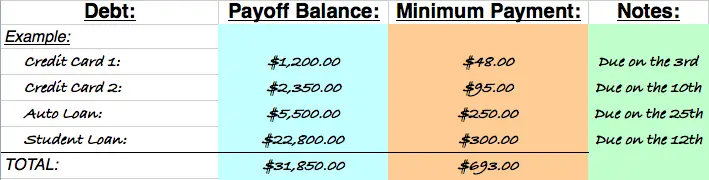
Let’s say your debt snowball looks like this:

<p>You are here: Home / Budgeting / Creating Your Payoff Plan – The Debt Snowball Method
Creating Your Payoff Plan – The Debt Snowball Method
January 21, 2024 | Leave a Comment

FacebookTwitterPinterestEmailShare
The purpose of this blog is to take you through the exact process that my husband and I have used to pay off more than $65,000 of debt in 11 months on a single middle class income.

To get you started on your journey, there are a number of things you need to do get your house in order.

1. Make a promise and get your spouse on board
2. Calculate your net worth
3. Review the checklist for a strong financial plan
4. Set your goals
5. Track your spending.

This posting is about a key part of the process in your debt payoff journey – developing a debt payoff plan using the debt snowball.

Subscribe Below and Get a “Jump Start Your Way Out Of Debt” Worksheet!

Now it is time to develop your payoff plan
This step is where you determine which debt you will pay off first, assuming you have more than one debt. We need to prioritize your debts so that you will focus on paying off one debt at a time.

If you make extra payments at one time toward all of your debts or even just a few, it will take much longer to realize significant results. This may lead to feelings of discouragement and frustration with the debt elimination process.

By focusing your energy on eliminating one debt at a time, you will see quicker results and earn a greater sense of accomplishment for all your hard work.

You will work on paying off the smallest balance first and make the minimum payments on each of the other debts.

Put as much money as you can each month toward the smallest debt.

Once that debt is paid off, you will cross it off (and celebrate!) and move on to the next debt on the list. Add the amount you have been paying on your first debt to the minimum payment for your second debt on your list and that becomes your new payment amount for your second debt.

This is called the debt snowball method. As you pay off the smaller debts, the amount of money you have available to pay off your bigger debts increases.

You will gain momentum as you rapidly cross the smaller items off your list. Paying off the smaller debts quickly gives you a series of “small wins.”

In his book “The Power of Habit” Charles Duhigg states, “Small wins fuel transformative changes by leveraging tiny advantages into patterns that convince people that bigger achievements are within reach.” Basically, this means that when you have a series of small wins and you see progress as your snowball grows, paying off the larger debts will feel more achievable.Capture Alt Title

By the way, Duhigg’s book is great, I recommend you pick up a copy if you get a chance.Capture Alt Title

Let’s look at an example
Let’s say your debt snowball looks like this:

Debt Snowball ExampleCapture Alt Title

Paying off your total debt of $31,850 probably feels overwhelming. Perhaps it is almost as much as your annual salary from your job. You might be thinking that it would be YEARS before you would be able to pay it all off.

And that might be true. It might be years but probably not as many as you think if you are intentional and focused on your goal.

Let’s say you work really hard in finding room in your budget (we’ll discuss strategies for this in a future post), and you are able to pay $500 toward Credit Card 1 each month while making the minimum payments on each of your other debts.</p>::Pexels

Paying off your total debt of $31,850 probably feels overwhelming. Perhaps it is almost as much as your annual salary from your job. You might be thinking that it would be YEARS before you would be able to pay it all off.

And that might be true. It might be years but probably not as many as you think if you are intentional and focused on your goal.

Let’s say you work really hard in finding room in your budget (we’ll discuss strategies for this in a future post), and you are able to pay $500 toward Credit Card 1 each month while making the minimum payments on each of your other debts.

After two-and-a-half months, you have paid off Credit Card 1!

The following month you add $500 to the minimum payment for Credit Card 2. We’ll say that amount is $95. So in month four, you pay $595 toward Credit Card 2.

At that rate, it will take you about four months to pay off Credit Card 2.

After eight months, you have paid off two credit cards totaling $3,550!

Achieving those quick, small wins makes paying off your auto loan feel much more attainable. Your enthusiasm for paying off your debt has increased, and now you are even more motivated to pay off your auto loan as quickly as possible so that you can move on to paying off your last debt!

In month nine, your excitement spurs you to find an additional $100 in your budget so instead of adding $595 to your auto payment, you are adding $695 to your minimum payment of $250.

How long do you think it will take you to pay off your auto loan when you are making payments of $945?

Possibly only five months because your balance has decreased while you have been working your debt snowball even though you have only been making the minimum payment up until this point.

After thirteen months you have paid off three debts totaling $9,050, and you are able to add $945 to your minimum payment for your student loan!

Even though your student loan balance may still be over $20,000, you realize that in thirteen months, you have been able to pay off almost a third of your original debt total. And as your income increases over time, you will be able to pay even more toward your student loan each month.

In this scenario, I anticipate that it might take you another year-and-a-half to pay off the student loan. As a result, it has taken you two-and-a-half years to pay off your total debt balance of $31,850!

Exciting, right?

And it is completely doable.

This is the method my husband and I have used to whittle away more than $87,000 of debt in 20 months on a single income, but our numbers were much larger.

If we can do it, you can do it too!

Keeping Up The Momentum – Should You Refinance?

If you’re making good progress on your debt payoff and your credit is good, you might consider refinancing. If you’re going to do this you might consider going with a company like SoFi. They’ve been making waves with their low priced loans.


READ MORE:

  • Self Lender Reviews: Building Credit With a Loan from Self Inc
  • Cash App Glitch 2023: Is the Free Money Glitch Real?
  • Try This $10000 Biweekly 26 Week Money Challenge to Crush Your Debt
  • Why You Need A Personal Mid-Year Budget Review and 5 Things to Do Now
  • How Often Should You Review Your Budget?

Filed Under: Budgeting

  • « Previous Page
  • 1
  • …
  • 18
  • 19
  • 20
  • 21
  • 22
  • …
  • 50
  • Next Page »
  • Email
  • Facebook
  • Pinterest
  • Twitter

Our Most Popular Articles

ClickCashGo Review: Should You Avoid At All Costs?

Ultimate Guide to Mastering Your Credit Score

The 'YOLO' Mindset is a Dangerous Thing

Dave Ramsey's Financial Peace University Review: Is it Worth the Money?

Cash App Glitch 2025: Is the Free Money Glitch Real?

Five Steps To Debt Freedom

Here are five simple guidlines that will help you pay off debt.  

1) Get an emergency fund so you don’t take on debt when something comes up.

2) List your debts. This way you know where you stand.

3) Use the debt snowball. Pay your debts from smallest to largest, or most expensive to least expensive.

4) Avoid new debt. No new credit cards or loans. Period.

5) Go all cash. After everything is paid off, switch to all cash.

Helpful Resources

U of Tennesse Debt Repayment Plan Basics

Vertex 42's Debt Payoff Calculator

Savingadvice's Helpful Debt Forums

Jackie Becks Debt Blog