Our Debt Free Family

Commit. Plan. Take action.

  • BUDGETING
  • DEBT REDUCTION
  • INVESTING
  • LIFESTYLE
  • TOOLS
  • ABOUT
  • Privacy Policy
  • CONTACT

Our January 2022 Debt Update

November 30, 2023 | Leave a Comment

<p>The end of January is nearly here already and I can't believe how quickly the month went by! I am happy to say that, during the first month of the year, we had some significant wins in our debt-free journey. Here's the latest debt update...</p>::Pexels

The end of January is nearly here already and I can’t believe how quickly the month went by! I am happy to say that, during the first month of the year, we had some significant wins in our debt-free journey. Here’s the latest debt update…

Emergency Fund Wins

The biggest win of January was getting our emergency fund fully re-established again. For now, we’ve only got $1,000 socked away. However, as we pay more things off, we will be adding to this. Because my husband and I work jobs that can vary in pay, it is extremely important to have a few months’ worth of expenses saved just in case.

Debt Update

Now, for the numbers…

Altogether, we made $1.,503 in payments towards our debts. This leaves us with the following account balances…

  • My Car Amount Owed: $20,217
  • Credit Card Total For Both: $487
  • Student Loans: $24,362 (my payment hasn’t yet hit my credit report from January)
  • Matco/Snap-On: $6,673
  • Amount in Collections: $679


Next Month

Next month we will at least make the same amount in payments and hopefully more. We also will continue to add money to our emergency fund when we have it. There are a few additional expenses occurring next month that will soak up a bit of our savings and debt payoff cash though.

We are preparing to register our car in Georgia (finally). Our North Carolina registration is up at the end of the month. To pass inspection here, register the car, and get our licenses, it will like cost around $1,000 (oof).

Outside of that, I can’t wait to update you on where we are in another month’s time. Remember, if you are on your own debt freedom journey that every tiny step forward counts, even if it seems insignificant now!

Readers, tell me about your recent debt wins! 

Read More

  • 52-Week Debt Reduction Challenge
  • How to Organize a Budget Calendar
  • My Word For 2023: Productivity
  • How Do You Create Reasonable Resolutions?

Filed Under: Budgeting Tagged With: debt progress, debt update

Is Being a Penny Pincher Losing You Money?

November 30, 2023 | Leave a Comment

<p>We all know at least one person that takes being "a penny pincher" to a whole new level. The ones that buy the cheapest toilet paper and pull the 2 sheets apart to make 2 rolls or the one that buys paper plates and tries to wash them.</p>::PexelsWe all know at least one person that takes being “a penny pincher” to a whole new level. The ones that buy the cheapest toilet paper and pull the 2 sheets apart to make 2 rolls or the one that buys paper plates and tries to wash them.

I would definitely classify myself as being a penny pincher, but hopefully not to the extreme stated above! (My husband might have a different opinion of this!)  From my experience, I’ve noticed that when one becomes too much of “a penny pincher,” it actually hurts your bottom line more than helps it. Here are some [Read more…]

Filed Under: Budgeting Tagged With: M, Our Debt Free Family

Dealing With Debt And How It Can Affect Your Children

November 30, 2023 | Leave a Comment

Debt is something that we all are, have, or will be dealing with in our lives, and it’s no secret that it can be quite the stressful experience. From stress about how we’re going to drum up the money, to the anxiety as to what might happen if we don’t can eat away at our nerves, but what about our children? How are they affected when we’re in debt? That’s what we’re exploring today. While online payday loans are available in a financial emergency, understanding how to deal with debt and how it could be affecting the little ones is a must – so read on to find out more.

How Does Your Debt Affect Your Children?

From babies and toddlers to older children and teenagers, your kids aren’t quite as oblivious to your stress as you might hope they are. The last thing any of us want is for our stress to rub off on our children, but the unfortunate fact of the matter is that it will – but is this always negative?

When we grow stressed, we may not be able to operate to our full potential no matter how hard we try and this obviously has an effect, especially on younger children. Stress can make us snappy, less inclined to spending time with the little ones and in general, completely different from how we normally operate. What’s more, a lower budget means that you may not be able to cater for the costs of school trips, socialising and they may have to go without basics when things get truly tough. As a result, a child’s mood, mental health and self-confidence could take a hit.

How Can You Deal With Your Debt?

With the above in mind, dealing with the debt you do have is vital. Stress is a natural reaction when things seem out of your hands, so it’s important to gain control where possible to help reduce stress on you, your bank account and your children. We’ve got a few tips below.

  • Face Facts

First things first, you need to stop, think, and face facts. Coming to terms with how much you owe, what your income and outgoings are and what you can realistically start to pay off without risking the quality of life for you or your kids. Track down paperwork, bank statements, open up bills you might’ve been otherwise been ignoring and actually work out everything you owe. This might seem counter-productive for your stress levels, but by organising your debts and laying them out separately, you can start to tackle them individually as opposed to a large, terrifying total sum.

  • Create A Budget

Remember the organisation you did in the above point? Well, now you can put it to some proper use. Crafting a budget is a great way to save money that you can put towards your debts without having to completely give up your lifestyle. While you might need to cut down on the leisure activities and swap them out for nights in or avoid the early morning coffee shop trips in favour of home-brewed alternatives, you can cut down your outgoing costs and put them where they’re needed more.

  • Prioritise

When it comes to the debts you owe, you need to prioritise as opposed to trying to pay them all off at once. To do this, all you need to do is work out which debts have the highest interest rates, and start pouring your money into them instead. Of course, you’ll need to pay the minimum charges on all of your debts, but with any extra cash, aim for one debt rather than spreading it out across multiple and once that is paid off, move onto the next and so on.

Debt is an unfortunate fact of life and while it’s possible to avoid some debts, there are others we have to take on and it can often be overwhelming. While our children can be affected by our financial stress, there are thankfully plenty of ways to get your debts under control and hopefully, our points above have given you a good place to start.

Filed Under: Budgeting

How to Avoid Catastrophic Health Care Costs for Your Parents

November 30, 2023 | Leave a Comment

<p>According to the Kaiser Family Foundation (KFF), "About a quarter (26 percent) of U.S. adults ages 18-64 say they or someone in their household had problems paying or an inability to pay medical bills in the past 12 months. Now think about these same statistics as people age. With age, health care needs and costs tend to increase. This potentially means more personal indebtedness for those with health care issues.</p>::Pexels

According to the Kaiser Family Foundation (KFF), “About a quarter (26 percent) of U.S. adults ages 18-64 say they or someone in their household had problems paying or an inability to pay medical bills in the past 12 months. Now think about these same statistics as people age. With age, health care needs and costs tend to increase. This potentially means more personal indebtedness for those with health care issues.

[Read more…]

Filed Under: Budgeting Tagged With: elderly care, health care expenses

How to Start Paying Off Debt, According to Dave Ramsey

November 30, 2023 | Leave a Comment

Dave Ramsey has been a go-to for personal finance advice for decades. Thousands, and possibly even millions, of people, have turned to him for what they should do next. Ramsey’s specialty is reaching financial freedom, which we all want. The first step to achieving financial independence is paying off your debt.

That sounds way easier than it is though – so, how do you start paying off debt? 

In the video above, a caller details his family’s financial struggle. At the time of the call, they were at least $96,000 in debt and had no clear plan of how to pay it off. Ramsey outlined the following steps to solve the family’s debt crisis.

  1. Get organized. First, get all of your finances into one place so you can see everything. Mint is a great tool to use for this!
  2. Know how much you owe. Once you have all your finances in one place so you can see how each part is moving, write down how much you owe and what kind of debt it is.
  3. Start writing down a budget at the beginning of every month. A written budget is a great way to keep on top of things and you’ll be able to see and plan every part of your finances.
  4. Sell everything you can. In the video, Ramsey tells the caller to sell his $27,000 car. It doesn’t always need to be that drastic, but you can look for things around the house to sell or even downsize to one car if needed.
  5. Identify ways to trim your budget. Once you have been budgeting a month or two, identify places to cut cost. For instance, you will need to cut eating out, going on vacation, and many other fun things to achieve your goal of being debt-free (but it will be worth it). Check out this Budget Planner.
  6. Make extra money when you can. Whether it is picking up a second job, selling personal items, or odd jobs, find a way to bring in some extra cash. Then, put all your newfound money towards paying off your debt.

If you’re interested in learning more about Dave Ramsey’s steps to getting out of debt, check out The Total Money Makeover.

Readers, have you read or listened to Dave Ramsey in the past? What do you think about his response above?

Filed Under: Budgeting Tagged With: Dave Ramsey, debt, debt free, financial freedom, financial independence, how to pay off debt, paying off debt, start paying off debt

Consolidation Loans Are Tempting – Here’s Why You Shouldn’t Get One

November 30, 2023 | Leave a Comment

<p>My debt situation and money situation hasn't necessarily improved since I last updated you here. Some major changes have been:</p>::Pexels

My debt situation and money situation hasn’t necessarily improved since I last updated you here. Some major changes have been:

  1. Open discussion about selling one of the cars.
  2. Finding other items in the house to sell.
  3. A solid plan to find my other half a job through temp agencies in the area.
  4. When we have $1,000 saved, we will begin to snowball every penny towards our debt until we are relieved of some of this pressure.
  5. After we are a bit more comfortable, we will increase our savings to cover a six-month emergency. That way, if either of us is out of work for an extended period again, we are prepared.

During the process of settling all this, one thing came up over and over: should we consider getting a consolidation loan. Of course, it would help us pay a lot of our “petty debt” in one fail swoop, but isn’t taking on new debt to pay off debt just continuing the cycle?

If you’re considering pulling out a debt consolidation loan, hear me out. They aren’t all bad all the time. They’ve helped some people out tremendously, but here are three reasons we opted out.

Say No To Consolidation Loans

There are a plethora of reasons to “just say no” to consolidation loans. You may be paying a higher interest rate for a longer period of time (even if the payment is lower). There is also no guarantee your interest rate will remain the same in many cases. Below are the three main reasons we decided not to consolidate.

1. Our Credit Scores Aren’t That Great

We are back in that spot where our credit scores aren’t that great. We’ve missed some credit card payments that have hit our credit. Luckily, we’re planning on building a life where we won’t need a credit score because we won’t be looking to take out any debts. Also, our payoff plan will slowly increase our scores over time.

2. Most Consolidation Loans Want Collateral

Many consolidation loans want to know that if you don’t pay there’s something they can hold as collateral. For me, they wanted my car – which is worth far more than I have to consolidate. That alone was enough for me to not want to move forward.

3. What Are You Learning From Taking Out a Loan?

As I chatted about in our debt update, we’ve become fans of Dave Ramsey. In general, he doesn’t “believe” in debt consolidation because it tricks people into thinking they are eliminating debt. When, in fact, you will be in debt longer by consolidating. It may impact your life in a positive way immediately but if you really want that financial freedom, we all need to learn how to be more patient and do things the “long” way. Which, in this case, will actually take less time.

Everyone’s Finances Are Different

You may be reading this saying, “But Amanda, a consolidation loan helped me and my family get back on the right track.” That is great! I’m happy for you. However, for my situation and current debt, a consolidation loan would simply elongate the amount of time I’ll be in debt. Not to mention, my other half and I feel we need this time of “discomfort” to really enjoy, appreciate, and maintain our financial freedom in the future.

After taking a look at our finances, many of our smaller debts, we could pay off in a single swoop if we made it our focus. A few of them will be paid off in the next few weeks (yay).

Readers, I’d love to hear back from you on this topic! Have you consolidated debt? Did it help or hinder your financial situation?

Read More

  • If You Must Get a Debt Consolidation Loan, Here is How
  • When is Debt Consolidation a Realistic Option?
  • Your Debt Doesn’t Define You
  • How to Start Paying Off Debt, According to Dave Ramsey

Filed Under: Budgeting

A Look At The Labor and Delivery Bill From When I Gave Birth

November 30, 2023 | Leave a Comment

<p>Bills are still trickling in from when I gave birth last August. Our little one entered the world on August 31 and, surprisingly, I wasn't hit with a mound of medical bills immediately. In fact, nothing started coming in the mail until late November regarding my labor and delivery bill. Here's a look at what the out-of-pocket cost will be for our family.</p>::Pexels

Bills are still trickling in from when I gave birth last August. Our little one entered the world on August 31 and, surprisingly, I wasn’t hit with a mound of medical bills immediately. In fact, nothing started coming in the mail until late November regarding my labor and delivery bill. Here’s a look at what the out-of-pocket cost will be for our family.

The Cost of Having a Baby

While I was pregnant, I researched the cost of having a baby and posted about it here on the blog. For a lot of people, it is shocking when the labor and delivery bill arrives and it is five figures. The average amount most women pay to give birth in a hospital is around $40,000. That’s if everything goes perfectly. Additional drugs or other medical intervention will cost more. For instance, I was induced and required medication for induction. This meant my pharmacy cost while in the hospital was higher than average, but we will look at a break down of the bill below.

There are plenty of other costs to giving birth in a hospital. Many people don’t consider what they’ll eat while they are there (and trust me, hospital food isn’t it). In fact, during COVID, some of the hospital’s services, such as food delivery, aren’t completely available. On top of that, you may be in the hospital longer than you think. My stay started Monday afternoon and we didn’t leave until Thursday morning. Some hospitals may charge parking during that period of time. Be sure you are prepared for that.

Some of these unexpected costs may throw people for a loop, but what really shocks most couples is when the labor and delivery bill arrives.

The Labor and Delivery Bill

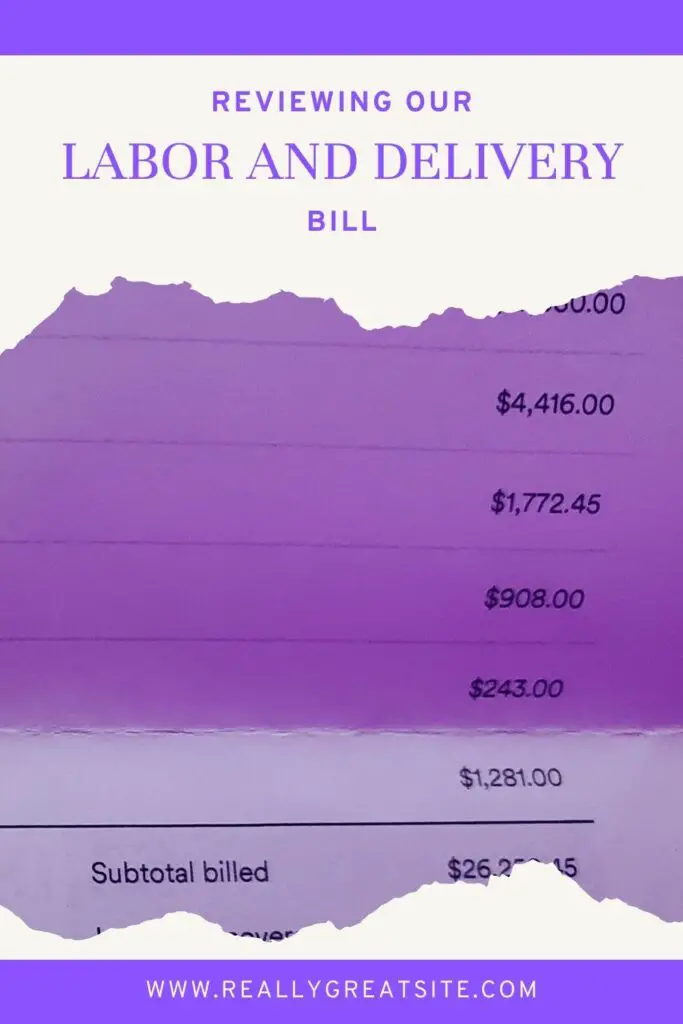
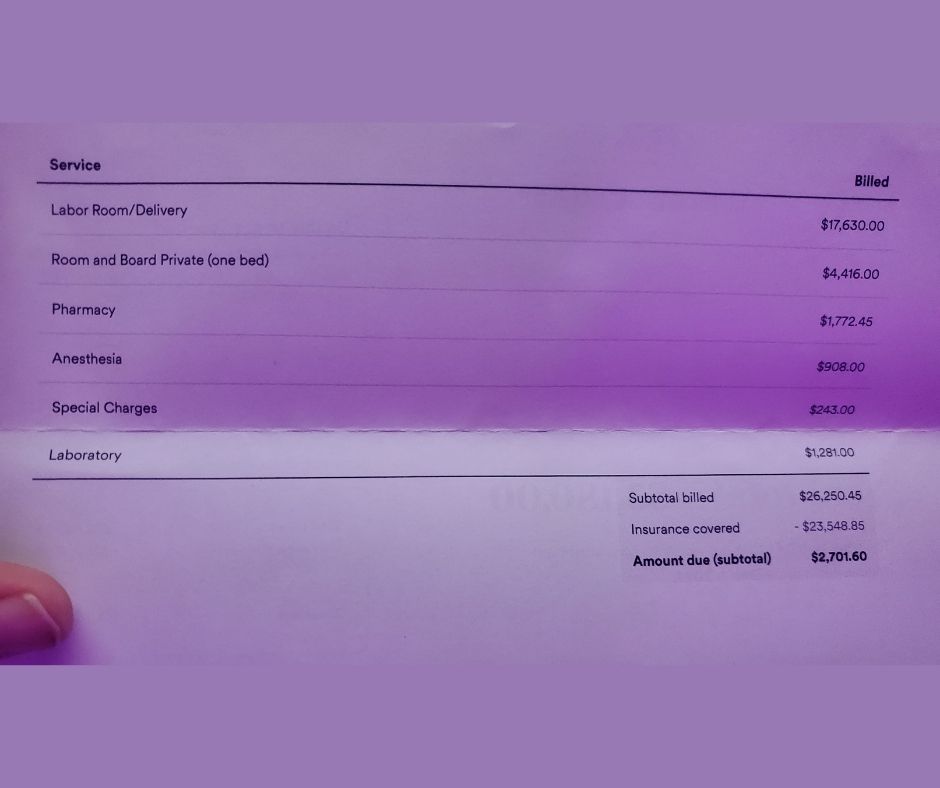
The dates I was in the hospital were August 30 through September 2. When the bill came from the medical center where I gave birth the total came to $26,250.40. Thankfully, my insurance is covering $23,548.85 of that. However, that still leaves me footing $2,701.60 of the bill. Here’s a break down…

<p>Labor Room/Delivery: $17,630
Room and Board Private (one bed): $4,416
Pharmacy: $1,772.45
Anesthesia: $908
Special Charges: $243
Laboratory: $1,281</p>::Pexels

  • Labor Room/Delivery: $17,630
  • Room and Board Private (one bed): $4,416
  • Pharmacy: $1,772.45
  • Anesthesia: $908
  • Special Charges: $243
  • Laboratory: $1,281

As mentioned above, I had to stay in the hospital a little longer than most mothers when they give labor. So, my room and board and paying for the labor room is a little higher than average. My pharmacy and laboratory costs are a little more expensive too. I went into the hospital because I was having trouble regulating my blood pressure. So, some additional medication was needed. Many people may pipe up and say we could’ve saved money by sharing a room too. During COVID that simply isn’t an option though, and you still have to pay the private room fees.

I honestly chuckled when I saw the bill. The most important part of labor/delivery was the anesthesiologist (that epidural saved me), but it is one of the cheapest item lines on the bill. The room, which is the most expensive part of the entire ordeal, was uncomfortable and the food was poor. At the end of it all though, we got our sweet little Chicken Nugget (her official nickname). She makes the labor and delivery bill irrelevant.

Read More

  • How We Plan to Reach Our 2022 Goals
  • How We’re Planning to Spend Christmas This Year
  • Unpopular Opinion: People Spend Too Much on Babies at Christmas

Filed Under: Budgeting

Selling Back Some of Our Debt

November 30, 2023 | Leave a Comment

<p>With recent career changes and a few months without a second income, we have been looking at ways to improve our finances. Like many other people during the pandemic, we experienced job loss and decreased wages last year. The loss in work pushed us to move sooner and make changes. One thing we settled on doing to help improve our situation was selling back debt that is no longer serving us. Here's how we are doing it.</p>::Pexels

With recent career changes and a few months without a second income, we have been looking at ways to improve our finances. Like many other people during the pandemic, we experienced job loss and decreased wages last year. The loss in work pushed us to move sooner and make changes. One thing we settled on doing to help improve our situation was selling back debt that is no longer serving us. Here’s how we are doing it.

Selling Back Debt

You may be thinking to yourself, “There is no debt that serves you.” However, when it comes to the debt we have had to take out to further our careers, it was serving us in a way. You may remember my husband’s tool debt from his time in the shop as a mechanic. When the pandemic hit, the shop he was working for downsized, and he was one of the newest employees, so he was cut.

This put us in a position where we had to continue paying for tools that weren’t being used as well as a storage unit to keep them in. It was a major drag on our finances overall. Eventually, because we no longer had that second income, it became impossible to keep up with the monthly payments. So, we started looking at our options.

At first, we looked at selling the toolbox and some of the tools to help pay off the debt. Once again, the pandemic made this pretty impossible. No one was looking to spend thousands of dollars on a toolbox when a lot of other people were out of work too. Eventually, the account went into collections early this year as we continued to look at our options.

How Selling the Debt is Helping Us

After discussing the issue with the company we are indebted to, they said they would be willing to buy back some of the items he had purchased and subtract the total from the amount owed. While this didn’t completely get rid of the debt we have, it did get the storage bill off our backs. It also decreased the amount we owed by $7,500 when all was said and done.

We didn’t get rid of everything either. They wouldn’t buy back used tools. So, my husband still has everything he needs in the event he wants to return to working in a shop or wants to do some side work as a mechanic. So, the security of having the tools for the job is still there.

For now, it also gets the monthly bill off our plate. Obviously, the amount in collections will still need to be paid off, but the $400+ monthly bill is not weighing on us at this very moment. We can shift our focus to paying off some other items, getting things caught up, and then settling with the collections agency later on in the year. For us, that is a win.

Readers, have you ever sold back debt like we did? 

Read More

  • How to Prepare for Big Life Changes
  • More Money, More Problems?
  • Why You Don’t Have to Choose Between Investing or Paying Off Debt
  • What Is the Real Problem Behind This Couples’ $232000 in Debt?


Filed Under: Budgeting Tagged With: how to sell your debt, selling back debt, selling your debt

How to Tell If You Are Suffering From Burnout

November 30, 2023 | Leave a Comment

<p>Here lately I've been feeling pretty burnt out. I'm burnt out on work. I am feeling burnt out with friendships and daily activities. All in all, I am really feeling the need to unplug, take a step back, and just breathe. However, I always find myself feeling guilty for taking that time off. I should be working, doing this and that. That guilt got me thinking about how burnout affects other parts of my life and how to identify when that break is needed.</p>::Pexels

Here lately I’ve been feeling pretty burnt out. I’m burnt out on work. I am feeling burnt out with friendships and daily activities. All in all, I am really feeling the need to unplug, take a step back, and just breathe. However, I always find myself feeling guilty for taking that time off. I should be working, doing this and that. That guilt got me thinking about how burnout affects other parts of my life and how to identify when that break is needed.

Signs of Burnout

Signs of burnout can be different for everyone, but there are some common symptoms that many people experience. According to Psychology Today, if you are feeling any of these things you may be experiencing burnout on some level:

Physical/Emotional Exhaustion

  • Anger
  • Anxiety
  • Chronic fatigue
  • Depression
  • Increased illness due to weakened immune system
  • Insomnia
  • Impaired concentration
  • Loss of appetite
  • Physical symptoms, such as chest pains, heart palpitations, and headache

Cynicism/Detachment

  • Feelings of detachment from others
  • Loss of enjoyment in things you usually love
  • Negative self-talk or pessimism
  • Self-isolation

Lack of Accomplishment Due to Burnout

  • Feelings of apathy
  • Irritability
  • Lack of productivity
  • Poor performance

Avoiding Burnout

Burnout is not unavoidable. In fact, there are a number of things you can do to make sure you don’t run yourself ragged (I just haven’t been doing them). Mommy Thrives is a mom blog that has covered some great ways to avoid burnout that you should try and implement in your day-to-day life. Here’s a quick list…

  • Change up your routine
  • Keep up with self-care
  • Schedule days where you are not working at all (or doing anything else for that matter)
  • Start a gratitude journal

How Burnout is Affecting Me

Like I said, great ideas, but I have not been doing any of that. I’ve been feeling a bit drained recently and I began thinking about the last time I truly took time off for myself. When you look at the list above, I ticked just about every box. Getting things done has been difficult. Some days it is hard to focus on all of the things that need to be done. It impacts my mood, my productivity, and, at times, it has an effect on our finances too.

More recently, I have had a lot of trouble sleeping, which was the biggest sign for me. Normally, I sleep pretty well and get around eight hours per night. Over the last few weeks, however, I have been waking up multiple times throughout the night. The sleep tracker on my smartwatch says I average between 30 and 50 minutes of deep sleep per night (Woah!). Now, this lack of sleep could be contributing to the rest of my symptoms, but when it comes down to it, I am burnt out. Period.

My mom always says, “The only thing you have to get done today is what you get done today.” I laugh when she says this because I think of my to-do list, which is normally about a mile long. But, really, how do you start to recover from burnout? What do you need to do to climb out of it and come back to your regular duties actually feeling refreshed?

Steps to Recover

Healthline wrote a great blog post about burnout and how you might be able to best recover if you hit that wall as I have.  Some of the suggestions include things like being firm about your boundaries and leaving work at work (two things I always struggle with). The blog also talked quite a bit about being in-tune with your own personal needs. On your days off, clear out your schedule and just relax. I’ll be honest, on my days off I’m usually running around checking even more things off my to-do list.

The Mommy Thrives blog mentioned mental health days and going on a hike. Hiking is one of my favorite things to do and I have not been on a hike since August 2019 (Yikes!). When it boils down to it, I’m not taking my downtime to truly tune into my personal needs or do anything I really enjoy. Instead, I’m thinking about all the things I could be doing.

Well, thankfully, I have a supportive husband who has seen this burnout coming from a mile away. He has been pushing me to do more things I enjoy and things to help my stress levels. I have started taking two yoga classes a week (which has been amazing) and in about a month we will both be unplugging for a long weekend at the beach. We never got our honeymoon and still actually have an Airbnb gift card from our wedding two years ago, so we will get one night free. While I’ll still have a month of work to do in the midst of this burnout, it is so nice to know I have these things to look forward to, to help me re-center.

Readers, how have you been able to recover from burnout in your own life? What tips do you have?

Read More

  • Selling Back Some of Our Debt
  • How to Prepare for Big Life Changes
  • Why You Don’t Have to Choose Between Investing or Paying Off Debt
  • More Money, More Problems?

Filed Under: Budgeting Tagged With: affects of burn out, burn out, financial burn out

How to Prepare for Big Life Changes

November 30, 2023 | Leave a Comment

prepare for big life changes

Any time there are big changes in our lives, the financial planning aspect of things gives me a bit of anxiety. I begin to think about every penny we will need to make the new shift in our lives go off without a hitch and, guess what? Things almost never go to plan. Not exactly anyway. So, we have had to put some thought into how to prepare for big life changes headed our way.

Huge Changes Coming Our Way

In a few weeks’ time, I hope to be able to share some positive news with you all on the blog. There are some HUGE changes coming our way. They are also changes that will involve some financial planning and saving on our part. As you know, we recently moved into a new home. On top of that, we’ve been going through even more changes that will impact our family in a big way.

Thankfully, my husband recently got a new job. He is able to work from home with me now and his income will greatly assist with these changes. We are aiming to get a substantial amount of money saved and then looking to double up on our debt payments. Hopefully, within the year, we will have our car 100% paid for (that is the goal anyway).

Since we have started planning for this big change coming up in our lives, it got me thinking about how others prepare for big life changes. Of course, there is nothing that works for everyone but there are several common ideas and things most people do when they are prepping for something big.

How to Prepare for Big Life Changes

Depending on what kind of change you are preparing for, the steps to get there will look different. If you are preparing to buy your first home, you will be making some financial sacrifices and also spending a great deal to get ready for that. If the changes you are making are more personal in nature, like quitting cigarettes or getting sober, your steps will look different. However, each of these tips seems to be applicable across the board.

  1. Surround yourself with supportive people. When you are going through something life-changing, you need to build a solid support system. Find people with who you feel comfortable talking about your upcoming changes with who you can rely to be supportive when you need them. In some cases, this may mean financial support or simply emotional support to get through the big change.
  2. Express your feelings often. One big mistake people make when they are going through a big transition in life is not expressing themselves clearly. When you aren’t able to make your own emotions and thoughts known, it becomes difficult to shake them. For instance, if you feel like you have hit a wall with your financial goals and feel stuck, express that frustration to someone you trust. Getting those feelings out will help you tremendously.
  3. Know why you are making the changes you are making. For each small goal you have, know why you are making those changes and how it contributes to the bigger picture. Knowing the “why” behind each move you make can help motivate you.
  4. Be realistic with expectations. Many people hit walls or stop seeing progress because they aren’t realistic with the goals they set. If you are facing a huge life change like we are, it is important that you are down-to-earth with what to expect of yourself and others. Change does not happen overnight.
  5. Allow for difficulty. Nothing ever goes according to plan, not exactly anyway. Make concessions for difficulties that may befall you along the way and don’t let them hold you back. Simply alter your plans to adjust for the bump in the road and move on.
  6. Practice self-care. No matter what, you need to continue to take care of yourself. Practice self-care in whatever way is most rewarding for you (just make sure it doesn’t hinder your progress). For some people, this may be taking time out of the day to unplug and read a book – that is my personal favorite. Others may need to work out or unplug and take a nice bath. Think about how you practice self-care and schedule time for those things while you are going through big changes. This will help you stay on track and keep you sane.

When it comes to how to prepare for big life changes there is no “how-to” guide. You need to find what works best for you mentally, emotionally, physically, and go with that. It may not look the same as what worked for your friends or family, but if it works for you, that is all that matters.

Readers, how have you gone about preparing for big life changes? What was key for you?

Read More

  • Why You Don’t Have to Choose Between Investing or Paying Off Debt
  • More Money, More Problems?
  • What Is the Real Problem Behind This Couples’ $232000 in Debt?
  • Frugal Date Ideas for All Year Long

Filed Under: Budgeting Tagged With: financial planning for big life changes, how to prepare for big life changes, prepare for big life changes

  • « Previous Page
  • 1
  • …
  • 34
  • 35
  • 36
  • 37
  • 38
  • …
  • 50
  • Next Page »
  • Email
  • Facebook
  • Pinterest
  • Twitter

Our Most Popular Articles

ClickCashGo Review: Should You Avoid At All Costs?

Ultimate Guide to Mastering Your Credit Score

The 'YOLO' Mindset is a Dangerous Thing

Dave Ramsey's Financial Peace University Review: Is it Worth the Money?

Cash App Glitch 2025: Is the Free Money Glitch Real?

Five Steps To Debt Freedom

Here are five simple guidlines that will help you pay off debt.  

1) Get an emergency fund so you don’t take on debt when something comes up.

2) List your debts. This way you know where you stand.

3) Use the debt snowball. Pay your debts from smallest to largest, or most expensive to least expensive.

4) Avoid new debt. No new credit cards or loans. Period.

5) Go all cash. After everything is paid off, switch to all cash.

Helpful Resources

U of Tennesse Debt Repayment Plan Basics

Vertex 42's Debt Payoff Calculator

Savingadvice's Helpful Debt Forums

Jackie Becks Debt Blog